Showing posts with label Article V. Show all posts

Sunday, October 2, 2016

When the Supreme Court Acts Like Politicians


The Supreme Court will start consideration of cases in its new term on the first Monday in October.  A Federalist Society panel previewing the Supreme Court's new term expected that SCOTUS will have a diminished case-load during the 2016-2017 term as it awaits confirmation of  Associate Justice Antonin Scalia's replacement. It  is assumed that the Supreme Court is avoiding some controversial cases to avoid having a 4-4 tie, which does not establish precedent and upholds the Appeals Court ruling.

There are several schools of thought concerning the vacancy on the Supreme Court.  If Democrat Presidential nominee Hillary Clinton (D-NY) wins the election but if the Republicans retain control of the Senate, there is good reason to believe that Obama designee Merrick Garland will be confirmed during the Lame Duck session.  Although Senate Majority Leader Mitch McConnell (R-KY) claims that Lame Duck sessions are not appropriate for SCOTUS confirmations, the thinking from the GOP may well be to go with the Devil they know rather than one which they don't know.

Some Democrats believe if they win both the White House and the Senate, then Hillary would want to install her own (presumably more progressive pick).  But some optimistic institutionalists hold fast to the notion that Mrs. Clinton would abide by the process and still push forward her predecessor's choice.  Either way, in such a scenario, it would be expected that there would be a lengthy evaluation and vetting process to achieve Senatorial Advice and Consent, thus keeping the evenly divided court well into the term.

Ass. Justice Anthony Kennedy
A more philosophical question is what should be the role of the Supreme Court.  A common rallying cry in Presidential elections is control of the Supreme Court.  Justice Scalia's passing in February levels an ideologically fractured SCOTUS (four liberals, three conservatives and Ass. Justice Anthony Kennedy), but with indications that progressives are itching to be more activist. 

Chelsea Clinton has mentioned on the hustings that openings the Supreme Court will allow her mother to fundamentally redefine the parameters of the Second Amendment.  

Most likely there would be no outright repeal of this fundamental freedom given by God, but it would take a narrow reading of the organic law and assert that this right is limited to organized militias. This would effectively make it a dead letter, like the Tenth Amendment.

So instead of being final arbiters of cases, the Supreme Court would act like a super-legislature, only they are unelected (thus unaccountable) and there is virtually no way to upend their ukases.
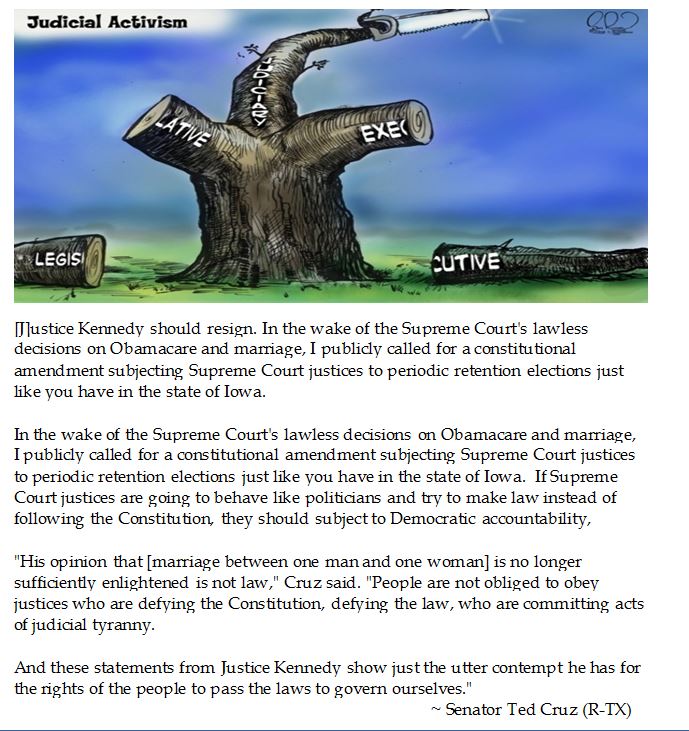
Sen. Ted Cruz Remedy to Judicial Activism and SCOTUS Ass. Justice Anthony Kennedy

Senator Ted Cruz (R-TX) while campaigning for President proposed having retention elections for the judiciary, as they do in Iowa.  That sounds more appealing on the campaign trail then it would be applicable in the Federal City. However, it does voice the frustration of many Americans who feel cut out of the governing process.  California twice approved referendums defining marriage (which was primarily a state issue), yet in Obergefell, the Supreme Court overturned the will of voters under a Right of Dignity interpretation of the Fourteenth Amendment and then expanded this right of same-sex marriage to all 50 states.

Two longer shot prospects not considered by judicial watchers are the possibility that Republican Presidential nominee Donald Trump (R-NY) might win and actually live by his promise to nominate conservative judicial candidates.  


The other way to remedy judicial tyranny would be limitations on Article III power.  While Congress can theoretically reign in lower courts, it is unlikely to do so. This would leave such reformation to application of an Article V Convention of States.  While the Article V safety valve for a Convention of States has been in place for 227 years, it has never been successfully invoked yet. But as more and more power is taken away from states yet they are saddled with the brunt of implementing dictates from the District of Calamity (sic), this may become a more feasible possibility. 

Sunday, July 20, 2014

Al Gore Agitates: "Our Democracy Has Been Hacked"


Sorry Al Gore, the United States of America is not a democracy, it is a Federal Republic which holds democratic elections.

The video kvetches that Congress can't pass meaningful gun control, thus the system has been "hacked".  Guess that the former Vice President hasn't read the Constitution lately.  There is something called a Second Amendment which involves the rights of citizens to bear arms. Even the Supreme Court in the Heller case reaffirmed that INDIVIDUALS have the right to keep and bear arms.

 If they Congress did want to do something about it, we would likely have to change organic law.  Perhaps the former Vice President has not read the Constitution lately, but there is something called the Second Amendment, which allows Americans to keep and bear arms.  Congress would have to vote 2/3rds in favor in each chamber and then it gets sent to the states, where 3/4ths of the states would be needed to ratify.  If states wanted to do something, they could try convening an Article V Convention of States.  More less radical activism on guns, this is the proper domain of the states.

Since Gore wanted to sound techie when referring to America's Democracy being hacked, it merits a geeky retort GIGO-- Garbage In, Garbage Out.


Friday, December 13, 2013

Some Quelling Qualms Over A Constitutional Convention of States


On the eve of the Mount Vernon Assembly, where nearly a hundred State Legislators gathered to discuss the framework for an Article V Convention of States, Phyllis Schlafly’s Eagle Forum issued an Action Alert decrying the effort.

***


 But a closer examination of the Action Alert reveals some specious arguments against what the Eagle Forum derides as a “Con Con”.

While it is true that there is not a tried and true tradition on the Article V Convention of States Amendment process, the Eagle Forum Action Alert did not seem to apply standard legal analysis to Article V.  The section reads:


The Congress . . . on the Application of the Legislatures of two thirds of the several States shall call a Convention for proposing Amendments . . .” [their emphasis in bold]


This leads the Eagle Forum to conclude that states only have the power to ask Congress for a convention and that the grant is discretionary.   This analysis under-plays the importance of the word “shall”, which means that if 2/3rds of the states make a similar request, Congress is mandated to call a convention. 


As the convention of states route to the Article V amendment process is uncharted territories, it is proper to be concerned about Congress seeking to take control of a convention.  The Eagle Forum alludes to efforts by Senator Sam Ervin (D-NC) and Representative Henry Hyde (R-IL 6th) to shape a prospective constitutional convention.  The problem is that neither the “Ervin bill” nor any Hyde bill ever was enacted.  

***

But these bills were stillborn, so such a corrupted process has not been figuratively chiseled into stone. 

It is dubious if the Framers of the Constitution would have established a secondary track for amending the Constitution if a Constitutional Convention would be like a super-empowered legislature.  Prior to the Constitutional Convention in 1787, the American colonies had a long history of Interstate Congresses.  This rich legislative history points to long established precedents of how a Convention of States ought to proceed.

In addition, fretting that States can only petition Congress for an Assembly ignores the will emanating from the State Legislatures who would call such an Article V Convention of States.   This is why the initial Mount Vernon Assembly session was so important, as it sought to establish ground rules for such a convention, and shared ideas for states to keep a convention under control.


IN State Sen. David Long (R-IN 16th, Ft. Wayne)
Indiana State Senator David Long (R-IN 16th, Fort Wayne) championed a Faithful Delegate law to accompany a call for an Article V convention of states.  This Faithful Delegate law precluded the prospective Convention of State participants from acting like free agents.  The Delegate would do the bidding of the State which they represented or their vote would be void, the delegate would be substituted and the maverick delegate would be subject to a felony.  Such is the cost of being a constitutional “free agent” with a Faithful Delegate law, unlike the slap on the wrist for Faithless Delegates in the Electoral College. 

***


A Convention of States  could well be structured like a contingent election when the Electoral College deadlocks.  In the case of a contingent election, each state delegate casts one vote and the deciding tally must meet a required threshold.  Colonial Congresses also had the one vote per State precedent.  The Mount Vernon Assembly focused on framework for a Convention of States rather than pressing potential amendment issues to build the base in case it comes to ripeness.

Another needless concern of the Eagle Forum Action Alert echoes earlier concerns about a runaway convention threatening the Bill of Rights and basic liberties enshrined to the current Constitution.  Such worriers should be placated that a Convention proposing Amendments can only licitly do what it is labeled “proposing Amendments” In order for such a Convention to send Amendments to States for ratification, it requires 2/3rds approval.  That is a high threshold, whether is it measured by individual delegates or single vote state methodology.  Even if such an Amendment made it past that mark, it would still need to garner 3/4ths approval of states through their legislatures or a truly never tried means of state conventions. 

The Eagle Forum is of the mind set that conservatives need to win elections.  This is a sentiment upon which all conservatives would concur.  However, it is dubious if just winning elections is the entire answer to problems in our polity  when the Administrative State can supersede the will of the people expressed by their legislature (e.g. Cap and Trade), autonomously expand its authority (e.g. FCC) as well as other unchecked abuses by the Executive Branch and the Judiciary.

It seems that on this issue, the Eagle Forum focuses on federal politics. However, reform of the Federal Government will only come from outside of the Federal City.  Article V provides a Constitutional mechanism for reforming our polity from outside of the District of Calamity (sic).  

In addition, conservatives power also lies within the State Legislatures, which could muster up to 30 States petitioning an Article V convention of states, which would create pressure on Congress to do something lest a Constitutional Convention be called. That is why the Mount Vernon Assembly took time to discuss process before proceeding.  Calling for an Article V Convention with strict instructions for delegates along with an Amendment like the Madison Coalition’s Regulation Freedom Amendment which could stand alone would set the stage for starting to restore the constitutional balance between Federal and State Governments. 

SEE MORE at DCBarroco.com

Wednesday, December 4, 2013

A Regulation Freedom Amendment to Reign in Excesses of the Administrative State


A GUEST POST by Jeffrey Barrett


Jeffrey Barrett
The rise of the Administrative State over the last few decades is perhaps the greatest threat to America’s constitutional Republic.  The Administrative State describes a form of government which delegates massive discretionary lawmaking power to unelected bureaucrats in federal agencies who are then responsible for enforcing their own laws. Such a behemoth bureaucracy is also known as  “The Welfare State”, “The Entitlement State” or “Big Government”.  But by any moniker, it is at odds with a governmental structure of separation of powers, checks and balances along with voter input and oversight.  The Regulation Freedom Amendment is a means to tame the Administrative State and return it to constitutional principles.

The Administrative State arose from Congressional delegation of details of the laws which they passed with the result that the burden was unloaded onto a swarm of Executive Branch agencies that administer, regulate and even adjudicate frequently vague legislation.   By Congress handing wide discretionary authority to bureaucrats to create regulations, it effectively gives these agencies the power to create laws as these regulations have the same force of law as enacted legislation.  Political scientist Joseph Postell has described these bureaucratic leviathans as nothing less than a “fourth branch” of government.

A major problem with the Administrative State is a lack of accountability.  When elected representatives give unelected bureaucrats authority to make laws, voters have no control over the faceless, nameless Civil Service protected federal workers.

The Administrative State also deprives citizens of the vital constitutional protection of the Separation of Powers, as federal agencies enact the regulations which they then enforce and often adjudicate.

To illustrate the conundrum, consider an average citizen dealing with the IRS, a small farmer or landowner engaging with the EPA or a small businessmen dealing with OSHA.  Your imagination, or perhaps personal experience, should convey the true impact of such “arbitrary power”.

One might wonder what can be done to check the Administrative State. The Madison Coalition points out that Article V of the U.S. Constitution   gives  state legislatures the authority to bypass Congress and implement a new Constitutional amendment that will check the routine excesses of the federal bureaucracies. The Madison Coalition calls their proposal “The Regulation Freedom Amendment.”


The notion for the Regulation Freedom Amendment is that if 1/4th of the States (13 total) or 25% of either the House or the Senate questions a federal regulation, then Congress would be required to formally call on a vote on the matter.   Thus states can force Congress to take responsibility for any regulation which states find too expensive, onerous or inane and voters will have their federal representatives on the record.   If Congress chooses not to take a transparent (or potentially embarrassing) vote, then that particular regulation becomes null and void.

A Regulatory Freedom Amendment would nudge the political system away from the arbitrary governance of the Administrative State towards “responsible” representative government.  It would give States, who are frequently the victims of unfunded federal mandates from the Administrative State, to act as a constitutional countervailing check on power of the alleged “fourth branch” of government.  A Regulation Freedom Amendment would temper the arrogance of power that  prevails amongst bureaucrats at some federal agencies, as some who would see themselves as victims would now have a means of fighting back.

To put the Regulation Freedom Amendment in place, it would behoove concerned citizens to contact their State Legislators to push this Amendment as well as Faithful Delegate Laws (like the now law crafted by Indiana State Senator David Long (R-16th, Fort Wayne) ) to prevent worries  that there would be a runaway Constitutional Convention.   After passage of the Regulation Freedom Amendment, legislators would discover the power that states have to correct the imbalance of power between the federal and state sovereigns.

This is an abridged version of an article which originally appeared in The Washington Times and was republished with the permission of the author. 

h/t: Madison Coalition
     Washington Times
     Eric Allie