

Some consider the Nation’s Capital as “Fantasyland on the Potomac”. Other outsiders are “Fed Up” with the Federal City. It's better to consider D.C. as “the District of Calamity” (sic).
Showing posts with label Cartoons. Show all posts
Showing posts with label Cartoons. Show all posts
Wednesday, February 27, 2019

Saturday, February 23, 2019

Friday, February 22, 2019
Thanks for Nothing AOC!
The Job Creators Network reacted to community activist turned freshman Representative Alexandria Ocasio Cortez's (D-NY 14th) celebration of chasing away Amazon from expanding its HQ2 to Long Island City (Queens), New York by erecting a pointed message at Times Square. The message offers some economic analysis for the loss of the business opportunity and sarcastically suggests: "Thanks for Nothing" AOC.

Wednesday, November 7, 2018

Friday, October 12, 2018

Friday, October 5, 2018

Tuesday, October 2, 2018
Democrats with a Loco -Motive (sic)

This loco label looms large in the mind of President Trump, as was echoed in his recent campaign rally in Johnson City, Tennessee.
What a Blooming-thal Liar (sic)

During the extraordinary hearings for Brett Kavanaugh's Supreme Court nomination, Senator Richard Blumenthal (D-CN) harkened back to his days as a prosecutor as he mangled a Latin admonition given in jury instructions that: "False in one thing, false in all things". But instead of impeaching Brett Kavanaugh, Da Nang Bloomenthal ironically impeached his own credibility.
When Richard Blumental was first running for the Senate, it was revealed that Bloomenthal had often boasted that he was a Vietnam War hero, when he had never been to Indochina during his military service.
That mendacity inspired President Donald Trump to sardonically cite the Connecticut Senator as Da Nang Richard.
If it was not invoked in such a sad situation, it would be funny. Somehow, it is unlikely that this just jibe will be satirized on Saturday Night Live.
Falsus in uno, falsus in omnibus indeed.
Monday, October 1, 2018

Tuesday, September 25, 2018

Friday, September 21, 2018


Wednesday, August 8, 2018


Thursday, June 28, 2018
On Applying the Nuclear Option and Comity
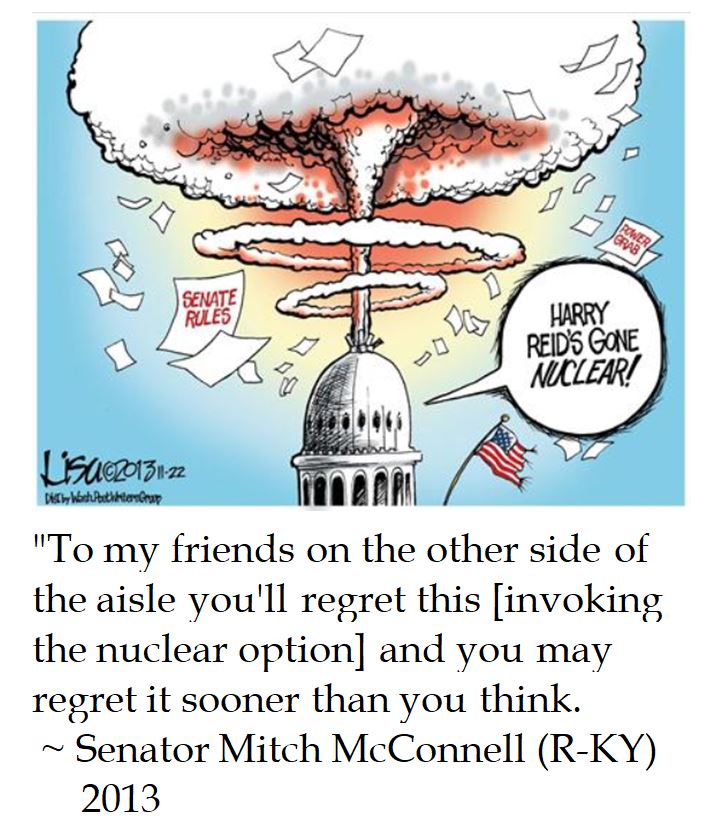
Article II Section 2 of the Constitution gives the United States Senate the prerogative to give "Advice and Consent" in confirming Executive Branch nominations, especially the judiciary. For most of the Republic, confirmations of Supreme Court justices were not voted on in a markedly partisan manner.
The Senate, which liked to consider itself as the world's greatest deliberative body, usually operated in a manner which vetted high court nominees in a conscientiously deferential manner to the President. For example, Ruth Bader Ginsburg had been chief counsel of the ACLU and a noted feminist attorney, yet she garnered a 93-3 confirmation vote in 1993.
 |
 And of course the vitriolic attacks on Robert Bork, President Ronald Reagan's 1987 pick to fill a Supreme Court opening, resulted in the verb "to Bork" to be added to the Oxford English Dictionary in 2002. But the adamant opposition from the left stemmed, however peripherally, to nitpicking "flaws" in the nominees.
Much of the comity that the Senate enjoyed was due to Cloture Rule (Senate Rule XXII) which was instituted in 1917. In order to end debate on a filibuster, three-fifths of Senators (today 60 votes) is required. Applying that to judicial nominees, Presidents often picked less stridently partisan or controversial candidates, as some Senate Minority votes were needed in order to advance to the confirmation vote.

Former Democrat Senate Majority Leader Harry Reid (D-NV) found this 3/5ths Cloture requirement to be inconvenient in his effort to aid President Barack Obama in packing the judiciary (particularly changing the balance in the 4th Circuit, a.k.a. "The Rocket Docket"). Thus, in 2013 Reid exercised "The Nuclear Option" which abrogated Senate Rule XXII for judicial confirmations save Supreme Court nominees.

Reid was warned on the Senate floor by then Republican Senate Minority Leader Mitch McConnell (R-KY) that you will regret using the nuclear option. In the 115th Congress, when Senate Democrats became openly obstructionistic about any nominations made by President Donald Trump, Majority Leader McConnell extended the "nuclear option" to include Supreme Court nominees, which resulted in Neil Gorsuch being confirmed by a 54-45 vote.
After Justice Anthony Kennedy's announced retirement from the Nation's High Court, Democrats have campaigned for the Senate to delay confirmation hearings for the SCOTUS opening until after the 2018 midterm elections. Their facile rationalization is that Republicans ought to follow the same standard used to deny Merritt Garland a confirmation hearing in 2016 because it was an election year. Of course, this partisan plea ignores that it was a Presidential election year and had over 70 years of precedent. In addition, Democrats are not in the majority and they set the agenda. Elections do have consequences.
So does changing and exploiting rules. Democrats might have some gravitas to their suggestion to stall SCOTUS confirmation hearing until after the midterms if they were not already slow walking nearly all Trump confirmations. Senate rules allow for 30 hours of debate on each nominee. Democrats have been routinely requiring the entire 30 hours of debate, which would mean that President Trump's picks could receive senatorial "advise and consent" in nine years. So the threat that Democrats will further slow walk Senate proceedings in retaliation or to forestall a SCOTUS confirmation vote is meaningless.
The recalcitrant response of Democrats should be a cue to Majority Leader McConnell on how to react to the diminution of comity in the Senate. If Democrats are going to slow walk everything in retaliation or retribution for the Senate leadership for exercising their "advice and consent" on Supreme Court nominees in a timely manner, then keep them in session. McConnell already effectively cancelled the traditional long summer recess so they can meet their budgetary duties. So they get to spend the dog days of summer on Capital Hill and enjoy the swampy weather in the District of Calamity (sic).
 But the lack of comity and the need for elected officials to do their job might mean spending more time on Capitol Hill. Since Democrats seem to relish filibusters and slowing the process down, the Majority Leader should change how filibutsters are treated. Instead of the failure of a cloture vote resulting in the legislation (or the nomination) being pulled, let the debate continue. If legislators want to invoke "Mr. Smith Goes to Washington" and talk until they are hoarse and drop from exhaustion, that is their prerogative. But just as the nuclear option changed things in unexpected ways, tinkering with the filibuster might have adverse effects on Senate minority rights in the future.
Moreover, so that the Senate is not simply the place where legislation goes to and dies, remain in session through October instead of taking the election break. From an objective standpoint, they will be doing their jobs (instead of concentrating on getting re-elected). Politically, this hurts Senate Democrats (as they have 25 of 33 seats up, including 10 in states where Mr. Trump won). And it might make obstructionism less appealing and allow incumbents to give comity a chance.
Monday, June 25, 2018


Friday, June 22, 2018


Thursday, June 14, 2018

Subscribe to:
Posts (Atom)