

Some consider the Nation’s Capital as “Fantasyland on the Potomac”. Other outsiders are “Fed Up” with the Federal City. It's better to consider D.C. as “the District of Calamity” (sic).
Showing posts with label Iowa. Show all posts
Showing posts with label Iowa. Show all posts
Tuesday, February 2, 2016

Monday, February 1, 2016
Iowa-- A Place Where Dreams Come True?

Will the winner of the Iowa Caucus believe that he found heaven in his political field of dreams, or will he be more concerned about being stuck in a hellish blizzard?
Sunday, January 31, 2016
One Day More to the Iowa Caucuses

One day more until the Iowa Caucuses. It will be good to have voters start actually participating in the primary process rather than hype the horse-race based on sketchy scouting reports.
 Donald Trump is the presumptive front-runner. He is always anxious to point to the polls and his huuuge crowds. Trump scored a couple of prominent endorsers, including former Governor Sarah Palin (R-AK) and Jerry Falwell, Jr. Trump was also aided by left handed compliments from current Governor Terry Branstad (R-IA), who is anxious to bolster ethanol mandates.
Trump eschewed the only Iowa debate supposedly because of a tiff with Fox News and Megyn Kelly. But Trump’s post-debate excited utterances at how Trump was glad to have missed the pummeling questions may be an admission against interest. Iowa voters expect to be courted and this cycle have remain undecided until the last minute. Will the Manhattan mogul’s reticence towards Iowa retail politics hurt him in the caucuses or will it be another one of many things his fanatics will forgive him?
Time will tell if celebrity campaigning draws in many first time caucus goers. In the 2012 cycle, only 125,000 people parcipated in the GOP Iowa Caucus. Patrick Murphy, the director of Mamouth University’s Polling Institute, opined: Trump’s victory hinges on having a high number of self-motivated, lone wolf caucus-goers show up Monday night.”. Add in the factor that many Trump-eteers are non-traditional first time caucus goers who have to be trained, motivated and ripe to turn out in Iowa, not just through social media or at a rally. If 150,000 or more Republicans actually participate (rather than just register) in this year’s Hawkeye Cauci, then it will be a good night for Trump.
 Senator Ted Cruz (R-TX) established an excellent ground game in Iowa while making pointed appeals to evangelical voters and Tea Party types (under the banner of being a consistent Conservative). Cruz claims to have 12,000 volunteers in Iowa. Even political operatives who do not support Cruz, such as Alex Castellanos, concede that Cruz has established a formidable social media operation.
Organization is key to driving caucus goers to the polls. Sometimes campaigns must literally drive their supporters there. Also having representative to speak at each caucus To aid in the retail campaigning, they rented college former dormitories and dubbed them “Camp Cruz” to house hundreds of door knocking volunteers. There has been some controversy over an 11th hour targeted voter mailer from the Cruz campaign which was intended to shame people into caucusing. Cruz dismisses such complaints claiming that the mailer was routine and he favored using every tool to get voters out to the Iowa Caucuses
Rather than pander to Iowa voters, Cruz advocated the elimination of ethanol mandates, and compromised by phasing them out over five years. But Cruz’ opponents and those supporting the ethanol lobby labeled that a “flip-flop”.
Cruz did score some significant endorsements for Iowans, including Tea Party favorite Representative Steve King (R-IA 4th), former Governor Rick Perry (R-TX), evangelical leaders Bob van der Plaats, and Tony Perkins, Duck Dynasty Commander Phil Robertson and radio personality Glenn Beck.
Cruz has barnstormed the Hawkeye State. By the time the caucuses start, Cruz claims that he will have done the full Grassley (referring to Iowa Republican Senator Charles Grassley) by having events in all 99 Iowa counties. This type of retail politics was rewarded in 2012, when former Senator Rick Santorum (R-PA) won a narrow victory against former Governor Mitt Romney (R-MA). The Cruz campaign has also outreached to twice the number of likely caucus-goers than Trump.
However, since Cruz rose towards the top of the Iowa polls in mid-December, he has been targeted by Trump over dubious “birther” (and now even “anchor baby”) attacks. Of late, Senator Marco Rubio (R-FL) has been joining the fray to claim that Cruz is running a “disingenuous” campaign. This has lead some political observers to conclude that Cruz peaked too early.
As the Iowa Caucuses approached, Cruz closed warning crowd of the dangers of voting for Trump and jabbed at Senator Marco Rubio (R-FL). This may evidence a lack of confidence of decisively winning the Iowa Caucuses as planned. However, weather forecasts project a major snowstorm starting just before the Caucus begin. While Haweyes are heartier than denizens in the District of Calamity, a lower turnout may be the key to victory for Cruz, as his organization gets dedicated supporters to turn out on a snowy February evening.
 Senator Marco Rubio has been coming on strong in Iowa, seemingly from good debate performances and wholesale politics via the airwaves. The Rubio campaign bet on de-emphasizing boots on the ground campaigning. In fact, Rubio deputy campaign manager Rich Beeson proclaimed: "The days of having to have 50 field staffers and 25 offices are done. We can have a field office and staff set up in a Starbucks with wireless and get just as much done as we can in a brick-and-mortar office with land lines." Perhaps. But does that compensate for the paucity of events in Iowa?
 Rubio’s Super PAC ran half hour informercials on the Saturday night before the Caucuses on 12 TV stations in five media markets. Will this work or just be noise as one flips channels on a Saturday night?
It would seem that Rubio is positioning himself for the third ticket out of Iowa, as the Caucuses tend to winnow the top tier winners from the campaign chaff. The strategy would be to frame the media story to be the Comeback Kid who comes out of no-where.
Iowa should have been the ideal launchpad for the Presidential aspiration of Dr. Ben Carson, as a Constitutional Conservative to appeal to Tea Partiers and a man of strong faith to appeal to evangelical voters, who make up 45% of Republican caucus goers. But Dr. Carson’s campaign has precipitously receded since being in the number two chair for the early December GOP debate. For the Iowa Debate, Carson only was allotted six minutes.
The Carson campaign has been bleeding top advisors for the last month in the run up to the Iowa Caucuses. Carson himself has admitted that if he does not do well in Iowa or New Hampshire that he might have to do an agonizing reappraisal. Senator Rand Paul’s (R-KY) campaign brags that they have 1,000 libertarian leaning collegiate supporters. If they turn out to the Caucuses, that might help lift Paul’s campaign from the primary doldrums. But if Dr. Carson were to be edged out of fourth place in Iowa by a surprise surge from Governor Chris Christie (R-NJ) or Senator Rand Paul , discernment time might come sooner.
As counter-programming to the Republican Debate which Donald Trump boycotted, he held an event to help veterans and wounded warriors, which raised $6 million for largess via the Donald J. Tump Foundation. Also appearing at the Trump for the Troops event were the two prior winners of the Iowa Caucuses former Sen. Rick Santorum (2012) and former Governor Mike Huckabee (R-AR). Both claimed that they wanted to support veterans but Santorum was more candid as he had nothing to do after participating in the under-card debate.
 |
| [L] Ex Sen. Rick Santorum (R-PA), [C] Donald Trump {R] Ex. Gov. Mike Huckabee |
Cynics see auditions to a prospective Trump Administration thus they seem like vassals for The Donald. Is it telling that Donald Trump will give his post Iowa Caucus “winning” speech in Little Rock, Arkansas.
It will be interesting to see how Big Mo goes after the Iowa Caucuses. Typically, the top three candidates get a rush of publicity and funding after Iowa. But Big Mo does not always translate into winning the next contest, as New Hampshire primary voters are contrarian. In the 2016 cycle, Trump is comfortably in the lead and Governor John Kasich (R-OH) is surging into second in the Granite State.
In this cycle, some campaigns have raised significant campaign contributions so they are unlikely to quickly fold after Iowa. Former Governor Jeb Bush (R-FL) seems resigned to garner better showings after Iowa and New Hampshire and Jeb!'s campaign has the money to make it there. Rubio’s campaign is well funded and can survive not winning in the Caucuses or the First in the Nation primary. Cruz has been conservative in spending his large campaign coffers and will probably concentrate on South Carolina and the SEC primaries on March 1st.
With all of this attention on the Grand Old Party, it is easy to overlook the Democrats. It is expected that 140,000 Hawkeye Democrats will participate in the Caucus and they skew very white and liberal. It would not be surprising if Senator Bernie Sanders (Socialist- VT) won both the Iowa and New Hampshire contests. Pro arguendo, Sanders momentum combined with the maelstrom of the Clinton Email Scandal, might cause the Democrat establishment to scramble for substitutes instead of the Hillary coronation, akin to 2004 after the Dean scream.
The fun begins in earnest on February 1st.
Tuesday, January 12, 2016
Santorum's Surprising Revelation

During an interview with Hugh Hewitt, 2016 Republican Presidential hopeful former Senator Rick Santorum (R-PA) marked the passing of David Bowie by owning up to liking some of the legendary Rock Superstar's music. Santorum also gave a nitty gritty explanation of the ground game in Iowa and how he hopes do do well in the caucuses.
Santorum's honesty should be commended as it was an admission against his interests. Much of the impetus for the Santorum for President run is about traditional family values, which hardly comports with Bowie's public aura. Santorum's choice may not win many votes in conservative evangelical circles as they go to caucus on February 1st.
While Santorum may have appreciated the audio artistry of the Starman, Santorum certainly did not emulate his fashion. And David Bowie (ne David Jones) would surely never be caught in the sweater vests that Santorum made infamous in 2012.
Monday, October 26, 2015
On Who Will Stand Up to Washington
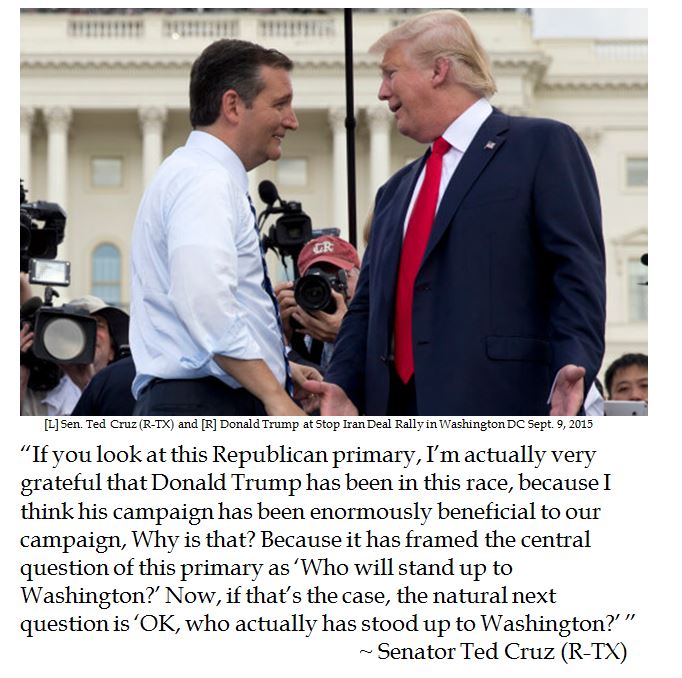
In his remarks before the Iowa Candidates Assessment Summit in Waterloo, Iowa, Senator Ted Cruz (R-TX) expressed gratitude for Donald Trump's participation in the 2016 Republican Primary process.
Is this actually honoring another outsider candidate or distinguishing without dissing? Senator Cruz has been adamant about adhering to Ronald Reagan's 11th Commandment to not criticize other Republicans personally, But now is the time when he has to start make his move to do well in the Iowa Caucuses to get winnowed into being competitive for GOP nomination.
Thus Cruz used his remarks before Tea Party types to bolster his own record of challenging the establishment Between the Beltways while recognizing who has hogged the spotlight during the silly season in the summer before a Presidential primary.
Will this work? Trumpeteers love politicians who are willing to fight, but many seem cemented to celebrating a curmudgeonous celebrity candidate. The question becomes whether these disaffected prospective voters just revel in a war of words or if they want someone who will really make DC listen.
Friday, October 23, 2015
Plotting Pathways to Primary Victory By Thinking In Time

When chatting with a friend who is not a political junkie, I questioned if Carly Fiorina’s strong Republican Debate performances can translate into strong showings in Iowa. My friend questioned the value of the Iowa Caucuses, considering that televangelist Pat Robertson won. With the Iowa Caucuses just a 100 days away, it is worth considering the importance of the early contest and assessing paths to primary victory.
This dialogue prompted me to review all Republican and Democrat Presidential Primary campaigns since 1976. The assertion that Pat Robertson won is an understandable misconception. He actually placed in second in 2000, thus proving that a campaign need not win in Iowa, but being in the top tier is important to survive the winnowing out. In the case of Senator Fred Harris (D-OK) in 1976, a fourth place finish with 9.89% support had Harris proclaim that he was "winnowed in” the race. Iowa many not pick a winner, but it typically does thin the field out.
Favorite son candidates can sometimes do well in Iowa just because of their connection or proximity to the Hawkeye State. Arguably, this was Rep. Dick Gephardt’s (D-MO 3rd) strategy in 1988. Some thought that such connections would have similarly helped former Congresswoman Michele Bachmann (R-MN 6th) or ex Governor Tim Pawlenty (R-MN), but this pathway to success proved futile. There was some speculation that in the 2016 cycle that Governor Scott Walker (R-WI) would have greatly aided by his native Iowan ties and being a next door neighbor, but that was not enough in the 2016 election cycle.
Iowa and New Hampshire are important because they test a can test a candidates endurance, organization and strategy. Because voters in the early primary states take their participation seriously, they expect to have lots of one-on-one encounters with hopefuls (retail politics). Former Senator Rick Santorum (R-PA) won Iowa in 2012 on a shoestring budget because of a grassroots effort to have town halls in all 99 counties.
What makes the “Haweye Cauci” unique is the fact that Iowa voters take their participation seriously and expect to be courted by aspiring politicians. Then there is the challenge of getting voters to show up at the Caucuses. Not only must they be motivated to spend several hours on a snowy Iowa evening to play politics, but they must represent their candidate. There are not private ballot boxes for Caucuses so Caucus goers must argue and advocate for their candidate. Thus a “silent majority” who acts according to their principles in the sanctity of the ballot box will not do. They must go before their neighbors and plead their candidates’ cases.
 |
| Iowa Howard Dean campaigner 2004 |

The Iowa contest may only sport 30 delegates split amongst the candidates, but doing well gives what 1980 GOP candidate (and later President) George Herbert Walker Bush called “The Big Mo”. Good publicity from being win place or show in Iowa can help for the next contest in New Hampshire.
But where “the Big Mo” really matters is in the “Invisible Primary” for donor dollars. When primary voters start selecting candidates (as Iowans do not vote), traditionally financial supporters either open the floodgates or cut off the flow of funds. People like to bet on winners and may jump on the bandwagon to curry favor with underdogs who outperform expectations. Some may claim that the “Invisible Primary” ends before selection process begins, because money in the bank allows for prudent allocation of resources. But sometimes candidates on the brink of financial collapse, like Senator John McCain in 2008 or Senator Rick Santorum’s shoestring start in 2012, needed the infusion of finances and publicity after doing well (or significantly beating expectations) in Iowa.

Doing well in the donor primary makes a difference in expanding organization and financing media buys several weeks down the road to effectively compete in a series of contests held on the same day, like the SEC primaries (March 1st) or in a populous and diverse state in which wholesale politics is essential, like Florida (March 15th)
In 2016, the GOP has rules that primaries before March 15th may have proportional distribution of delegates, after that time it is winner take all. Party rules this cycle also require candidates to win six contests. Candidates need to find their pathway to victory.
Some Republican candidates choose not to put as much emphasis on Iowa as it is not a reliable predictor of success and the agrarian and evangelical midwestern voters may not suit certain campaigns. The eastern and western edges of Iowa seem to vote for more urban and moderate candidates in GOP primaries while the center of the state can be characterized as quite evangelical and values voters. Santorum squeaked out a victory in 2012 with a campaign appealing to value voters and retail politics. Governor Mike Huckabee (R-AR) beat Governor Mitt Romney (R-MA) 30%-27% by winning with “very conservative” voters, many of whom were evangelical value voters.
The importance of Iowa was demonstrated by the quick reversal of a social media faux pas by Donald Trump. The brash businessman has earned a reputation of raring for a fight and never backing down. While Mr. Trump has been top of the Republican polls for the last 100 days, but a recent poll showed that he dropped in second place in the Hawkeye State behind another outsider candidate Dr. Ben Carson. Trump's Twitter account, which he had leveraged for publicity to personally comment during the Democrat debate, forwarded a snarky dismissal of the poll, denegrating Iowans.

Within a couple of hours, the Trump campaign deleted the tweet and expressed the regret for a young intern for the gaffe. OK. so much for spoiling for a fight and never backing down as well as the aura of authenticity. But it goes to show the importance of not offending Hawkeyes and alienating the Charm of Iowa Stubborn

If not Iowa, Republican candidates have to rely on doing well in New Hampshire, the first primary state. The Granite State had a long reputation for picking Republican winners, with a couple of notable recent excecpion. Typically, New Hampshire voters are contrarian rejecting Iowa’s lead. Candidates sometimes camp out there to do tons of town hall meetings to maximize retail politics. Senator John McCain (R-AZ) used it as his breakout moment in 2008. Conventional wisdom is that if you don’t do well in Iowa or New Hampshire, it is wise to hang it up.
A few contemporary candidates have sought to eschew the Iowa Caucuses and the First Primary in New Hampshire, much at their peril. In 2008, Mayor Rudy Giuliani (R-NYC) calculated that he would win the Sunshine State due to the number of transplanted New Yorkers. So he essentially skipped Iowa, New Hampshire, Michigan, South Carolina and Nevada. To his chagrin, Giuliani only garnered 14.7% of the vote. On top of that, any delegates won were cut in half since the Florida primary was held too early for Republican rules.
In 2012, Gov. Jon Huntsman (R-UT) iconoclastically set up his campaign HQ in Orlando thinking that Florida would lead to victory. But Huntsman came in third in New Hampshire and dropped out by Florida.
The 2016 GOP Primary cycle features a crowded field and seems strongly influenced by debate performances. After the second debate at the Reagan Library, businesswoman Carly Fiorina catapulted up to third place in the national polls. All of that is well and good, but political pundits need to consider what is her plausible path to victory? At this late stage in the campaign, can an unknown candidate build an organization for effective retail politics in the caucuses or does someone like Fiorina hope that Granite State contrarianism carries the day? Would publicity from an early primary win be enough to build a successful campaign for the SEC primaries or is the hope to be the last acceptable alternative to a frontrunner or establishment candidate?
Frontrunners in the summer before a Presidential campaign year typically do not get the nomination, otherwise there might have been a President Dean (2004), President Gephardt (2008) or President Giuliani (2008). Hardball questions often hinder early frontrunners. The trick is to peak and the right time and not get in too late. In the 1980 cycle, then former Governor Ronald Reagan only announced his candidacy in November 1979 and had to rush to organize for Iowa. But back then a late entry was feasible. In the summer of 2007, Senator Fred Thompson (R-TN) announced in late for the 2008 primaries and had trouble getting traction and fundraising. In 2011, Governor Rick Perry (R-TX) joined the 2012 GOP primaries after the Ames Straw Poll, but was hindered by the late start and a monumentally bad debate performance.
In the 2016 cycle, it has been postulated that Senator Ted Cruz (R-TX) is wisely waiting in the background to pounce when the primaries start. Cruz was the first to announce with a strong religious liberty stance that would appeal to evangelical voters. Cruz is accused by Republican Party elites for pushing for show votes on principled policies (e.g. really repealing Obamacare, Iran Nuke Deal, defunding Planned Parenthood) which underline his “outsider” bona fides while still serving in the District of Calamity. Cruz has a strong campaign war chest. All signs point to strong organization in early contests and the SEC primaries. Cruz is also competing in very small contests (like Guam and Puerto Rico) which are essential to winning enough contests to be considered for nomination. Cruz is a skilled debater who has made good use of the limited time he has been given in debates and he has not made enemies with his opponents. Yet at the beginning of autumn 2015, Cruz is placing 5th out of 15 with 8% support in polls.
Cruz’s path to victory would need to do well in Iowa (especially with very conservative and evangelical voters), be competitive in New Hampshire, rebound in conservative South Carolina and then be successful in the bulk of SEC primaries (including his home state of Texas) on March 1st. This slow and steady success strategy does not have the sizzle of Trump or the establishment imprimatur for former Governor Jeb Bush (R-FL), but is solid strategy that has a pathway to victory. Whether or not this works remains to be seen.
Looking at the GOP primaries methodically may not be as much fun as hobnobbing about the horse race with always changing polls, but it understands the primary process and gives benchmarks for successful strategy rather than a blind bandwagon approach to campaigns.
Subscribe to:
Posts (Atom)