As former 2016 Republican Presidential candidate Carly Fiorina endorsed her erstwhile rival Senator Ted Cruz (R-TX) for the GOP nomination, she let loose on the buying and selling of political access. Fiorina was tough on GOP front runner Manhattan mogul Donald Trump as well as the likely Democrat nominee former First Lady/Senator/Obama Secretary of State Hillary Clinton (D-NY).
Showing posts with label Carly Fiorina. Show all posts
Wednesday, March 9, 2016
Wednesday, February 10, 2016
Thursday, January 14, 2016
Wednesday, December 16, 2015
Thursday, December 10, 2015
Friday, October 23, 2015
Plotting Pathways to Primary Victory By Thinking In Time
When chatting with a friend who is not a political junkie, I questioned if Carly Fiorina’s strong Republican Debate performances can translate into strong showings in Iowa. My friend questioned the value of the Iowa Caucuses, considering that televangelist Pat Robertson won. With the Iowa Caucuses just a 100 days away, it is worth considering the importance of the early contest and assessing paths to primary victory.
This dialogue prompted me to review all Republican and Democrat Presidential Primary campaigns since 1976. The assertion that Pat Robertson won is an understandable misconception. He actually placed in second in 2000, thus proving that a campaign need not win in Iowa, but being in the top tier is important to survive the winnowing out. In the case of Senator Fred Harris (D-OK) in 1976, a fourth place finish with 9.89% support had Harris proclaim that he was "winnowed in” the race. Iowa many not pick a winner, but it typically does thin the field out.
Favorite son candidates can sometimes do well in Iowa just because of their connection or proximity to the Hawkeye State. Arguably, this was Rep. Dick Gephardt’s (D-MO 3rd) strategy in 1988. Some thought that such connections would have similarly helped former Congresswoman Michele Bachmann (R-MN 6th) or ex Governor Tim Pawlenty (R-MN), but this pathway to success proved futile. There was some speculation that in the 2016 cycle that Governor Scott Walker (R-WI) would have greatly aided by his native Iowan ties and being a next door neighbor, but that was not enough in the 2016 election cycle.
Iowa and New Hampshire are important because they test a can test a candidates endurance, organization and strategy. Because voters in the early primary states take their participation seriously, they expect to have lots of one-on-one encounters with hopefuls (retail politics). Former Senator Rick Santorum (R-PA) won Iowa in 2012 on a shoestring budget because of a grassroots effort to have town halls in all 99 counties.
What makes the “Haweye Cauci” unique is the fact that Iowa voters take their participation seriously and expect to be courted by aspiring politicians. Then there is the challenge of getting voters to show up at the Caucuses. Not only must they be motivated to spend several hours on a snowy Iowa evening to play politics, but they must represent their candidate. There are not private ballot boxes for Caucuses so Caucus goers must argue and advocate for their candidate. Thus a “silent majority” who acts according to their principles in the sanctity of the ballot box will not do. They must go before their neighbors and plead their candidates’ cases.
![]() |
| Iowa Howard Dean campaigner 2004 |
The Iowa contest may only sport 30 delegates split amongst the candidates, but doing well gives what 1980 GOP candidate (and later President) George Herbert Walker Bush called “The Big Mo”. Good publicity from being win place or show in Iowa can help for the next contest in New Hampshire.
But where “the Big Mo” really matters is in the “Invisible Primary” for donor dollars. When primary voters start selecting candidates (as Iowans do not vote), traditionally financial supporters either open the floodgates or cut off the flow of funds. People like to bet on winners and may jump on the bandwagon to curry favor with underdogs who outperform expectations. Some may claim that the “Invisible Primary” ends before selection process begins, because money in the bank allows for prudent allocation of resources. But sometimes candidates on the brink of financial collapse, like Senator John McCain in 2008 or Senator Rick Santorum’s shoestring start in 2012, needed the infusion of finances and publicity after doing well (or significantly beating expectations) in Iowa.

Doing well in the donor primary makes a difference in expanding organization and financing media buys several weeks down the road to effectively compete in a series of contests held on the same day, like the SEC primaries (March 1st) or in a populous and diverse state in which wholesale politics is essential, like Florida (March 15th)
In 2016, the GOP has rules that primaries before March 15th may have proportional distribution of delegates, after that time it is winner take all. Party rules this cycle also require candidates to win six contests. Candidates need to find their pathway to victory.
Some Republican candidates choose not to put as much emphasis on Iowa as it is not a reliable predictor of success and the agrarian and evangelical midwestern voters may not suit certain campaigns. The eastern and western edges of Iowa seem to vote for more urban and moderate candidates in GOP primaries while the center of the state can be characterized as quite evangelical and values voters. Santorum squeaked out a victory in 2012 with a campaign appealing to value voters and retail politics. Governor Mike Huckabee (R-AR) beat Governor Mitt Romney (R-MA) 30%-27% by winning with “very conservative” voters, many of whom were evangelical value voters.
The importance of Iowa was demonstrated by the quick reversal of a social media faux pas by Donald Trump. The brash businessman has earned a reputation of raring for a fight and never backing down. While Mr. Trump has been top of the Republican polls for the last 100 days, but a recent poll showed that he dropped in second place in the Hawkeye State behind another outsider candidate Dr. Ben Carson. Trump's Twitter account, which he had leveraged for publicity to personally comment during the Democrat debate, forwarded a snarky dismissal of the poll, denegrating Iowans.
Within a couple of hours, the Trump campaign deleted the tweet and expressed the regret for a young intern for the gaffe. OK. so much for spoiling for a fight and never backing down as well as the aura of authenticity. But it goes to show the importance of not offending Hawkeyes and alienating the Charm of Iowa Stubborn

If not Iowa, Republican candidates have to rely on doing well in New Hampshire, the first primary state. The Granite State had a long reputation for picking Republican winners, with a couple of notable recent excecpion. Typically, New Hampshire voters are contrarian rejecting Iowa’s lead. Candidates sometimes camp out there to do tons of town hall meetings to maximize retail politics. Senator John McCain (R-AZ) used it as his breakout moment in 2008. Conventional wisdom is that if you don’t do well in Iowa or New Hampshire, it is wise to hang it up.
A few contemporary candidates have sought to eschew the Iowa Caucuses and the First Primary in New Hampshire, much at their peril. In 2008, Mayor Rudy Giuliani (R-NYC) calculated that he would win the Sunshine State due to the number of transplanted New Yorkers. So he essentially skipped Iowa, New Hampshire, Michigan, South Carolina and Nevada. To his chagrin, Giuliani only garnered 14.7% of the vote. On top of that, any delegates won were cut in half since the Florida primary was held too early for Republican rules.
In 2012, Gov. Jon Huntsman (R-UT) iconoclastically set up his campaign HQ in Orlando thinking that Florida would lead to victory. But Huntsman came in third in New Hampshire and dropped out by Florida.
The 2016 GOP Primary cycle features a crowded field and seems strongly influenced by debate performances. After the second debate at the Reagan Library, businesswoman Carly Fiorina catapulted up to third place in the national polls. All of that is well and good, but political pundits need to consider what is her plausible path to victory? At this late stage in the campaign, can an unknown candidate build an organization for effective retail politics in the caucuses or does someone like Fiorina hope that Granite State contrarianism carries the day? Would publicity from an early primary win be enough to build a successful campaign for the SEC primaries or is the hope to be the last acceptable alternative to a frontrunner or establishment candidate?
Frontrunners in the summer before a Presidential campaign year typically do not get the nomination, otherwise there might have been a President Dean (2004), President Gephardt (2008) or President Giuliani (2008). Hardball questions often hinder early frontrunners. The trick is to peak and the right time and not get in too late. In the 1980 cycle, then former Governor Ronald Reagan only announced his candidacy in November 1979 and had to rush to organize for Iowa. But back then a late entry was feasible. In the summer of 2007, Senator Fred Thompson (R-TN) announced in late for the 2008 primaries and had trouble getting traction and fundraising. In 2011, Governor Rick Perry (R-TX) joined the 2012 GOP primaries after the Ames Straw Poll, but was hindered by the late start and a monumentally bad debate performance.
In the 2016 cycle, it has been postulated that Senator Ted Cruz (R-TX) is wisely waiting in the background to pounce when the primaries start. Cruz was the first to announce with a strong religious liberty stance that would appeal to evangelical voters. Cruz is accused by Republican Party elites for pushing for show votes on principled policies (e.g. really repealing Obamacare, Iran Nuke Deal, defunding Planned Parenthood) which underline his “outsider” bona fides while still serving in the District of Calamity. Cruz has a strong campaign war chest. All signs point to strong organization in early contests and the SEC primaries. Cruz is also competing in very small contests (like Guam and Puerto Rico) which are essential to winning enough contests to be considered for nomination. Cruz is a skilled debater who has made good use of the limited time he has been given in debates and he has not made enemies with his opponents. Yet at the beginning of autumn 2015, Cruz is placing 5th out of 15 with 8% support in polls.
Cruz’s path to victory would need to do well in Iowa (especially with very conservative and evangelical voters), be competitive in New Hampshire, rebound in conservative South Carolina and then be successful in the bulk of SEC primaries (including his home state of Texas) on March 1st. This slow and steady success strategy does not have the sizzle of Trump or the establishment imprimatur for former Governor Jeb Bush (R-FL), but is solid strategy that has a pathway to victory. Whether or not this works remains to be seen.
Looking at the GOP primaries methodically may not be as much fun as hobnobbing about the horse race with always changing polls, but it understands the primary process and gives benchmarks for successful strategy rather than a blind bandwagon approach to campaigns.
Labels:
Carly Fiorina,
Donald Trump,
Elections,
George HW Bush,
GOP,
Iowa,
John McCain,
Mike Huckabee,
New Hampshire,
Pat Robertson,
Politics,
Republican,
Rick Perry,
Rick Santorum,
Ronald Reagan,
Rudy Giuliani,
Ted Cruz
Tuesday, October 20, 2015
On The Cruz Effect and the Capitol Hill Cocktail Party
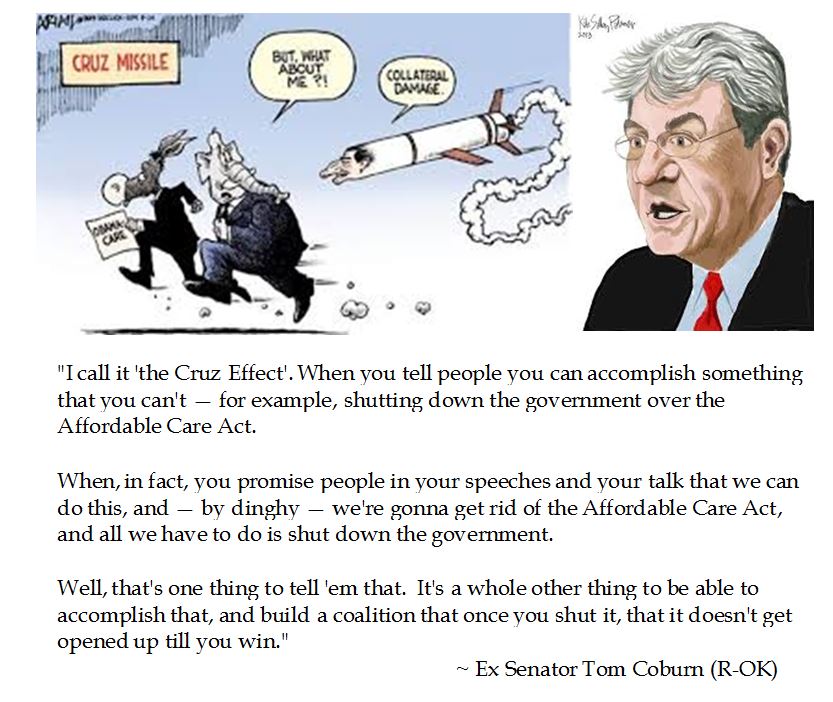
Former Senator Tom Coburn (R-OK) was recently interviewed on Sirius-XM radio by Pete Dominick in which he disparaged "The Cruz Effect". Coburn chaffed at lawmakers being put in a position to make desperate stands about legislative items which he believes have no chance of overcoming a veto. This was not the first time in which Coburn raised this reluctance to futilely fight. Coburn said similar things to Joe Scarborough on MSNBC's Morning Joe in 2013.
Senator Coburn was a 20 year veteran of the Senate and had developed a reputation for being "Dr. No" for his conservative intransigence. Yet before retiring to tend to his Colon Cancer after the 2014 election cycle, Senator Coburn exhibited an animus against Tea Party types, with Huffington Post headlines bragging of a Coburn Smack Down of the Tea Party. Coburn was quick to condem Senator Cruz's shut down tactic on Obamacare. Some Tea Party constituents wondered if he was a Charlatan, Traitor or Patriot for his go along to get along Senatorial approach gun control.
Although he is no longer in the Senate, Senator Coburn is pushing a Cocktail Party approach to things. In Oklahoma, it is not hard to sound conservative and promise to repeal Obamacare, protect the second amendment or now even to defund Planned Parenthood. But where the rubber meets the road in legislating in the District of Calamity, intentions and ardor matter.
When speaking to Scarborough about Obamacare in 2013, Senator Coburn rightly points out that Republicans did not have 67 votes to overcome an expected Presidential veto from Barack Obama. Right. So when has either party had vetoproof supermajorities in the Senate? Not in nearly half a century. In the 89th Congress (1965-67), Democrats held 68 seats in the Senate and 295 House seats. During the New Deal, Democrats had veto proof majorities in the 74th and 75th Congresses (1935-39). During Reconstruction after the Civil War, there were veto proof majorities for Republicans in the 39th, 40th, 41st and 43rd Congresses.
So having an assured veto proof majority is a rarity in American polity. Nowadays, the benchmark seems to be reaching Cloture (now set at 60 votes in the Senate). After the election of Barack Obama and the eventual seating of Senator Al Franken (D-MN), Democrats had Cloture proof majority until Senator Scott Brown, the elected replacement for Senator Ted Kennedy (D-MA) was seated (replacing interim Senator Paul Kirk (D-MA)).
So it is fanciful for a Republican to think that their measures will have veto-proof (or Cloture proof) majorities by party votes alone through regular legislative procedures. But does that mean not doing anything because you are unsure if it will be enacted?
The reason why the comments of a former Republican Senator matter is that it epitomizes the conflict on Capitol Hill for the next Speaker and is a reason why outsider Republican Presidential candidates like Donald Trump, Ben Carson, Carly Fiorina and Senator Ted Cruz (R-TX) are leading in the polls.
What has been called the Surrender Caucus is only happy to fight for bills which they are certain will be enacted. Sure, you can campaign conservatively for the "rubes" back home, but politicians who are comfortably ensconced in the District of Calamity Cocktail Party won't spend any political capital for causes in which victory is uncertain. Hence they surrender without a real fight.
For example, with the recent effort to defund Planned Parenthood, there were attempts to attach a rider onto a Continuing Resolution to divert funding for womens' health from the embattled abortionists to community health centers. The Byrd Rule for budget bills only required 51 votes for passage (avoiding a Cloture Vote). But President Obama promised to veto the CR and Republican Leadership feared that it might be blamed for a government shut down. So they surrendered without a fight and Senate Majority "Leader" Mitch McConnell jammed down a clean CR through December 11th. This was not a one-off but was indicative of a pattern, which Tea Party renegades like Cruz have exposed for the shame that it is.
It might have been messy, but having must pass legislation like the Highway Bill, a Continuing Resolution or a real Congressional Budget with liberally unappealing riders might have forced the hand of President Obama to shut the government down. If the Republicans had a better communication strategy, they might not automatically be blamed for shutting the government down when it was an Executive Branch veto which did the dirty deed. As the branches sought to craft a resolution, concessions might be extracted. So in the case of Obamacare (a.k.a. the Affordable Care Act), a nigglesome provision like the employer mandate could be up for grabs, which eventually would kill the clunky and unpopular system. But that involves some guts to take a political risk and then be ready to fight hard in the media and on Capitol Hill.But it's so much easier to, echoing Mr. Coburn: "Dingity, we tried but we just didn't have the votes to do it. Too bad (but we'll still rail against it for the next election).
The House Republican Caucus is set to nominate another candidate for Speaker. Despite the entreaties of Speaker John Boehner that he is retiring after the crowing achievement of his Congressional career of having Pope Francis speak before a Joint Session of Congress, the reality is that he was set to resign because he would lose a Vacate the Chair vote. Boehner could not win the necessary votes in the GOP Caucus because the Freedom Caucus both wants a leader who will fight but will also vote on their legislation rather than dictate what will be voted on (and will will or will pointedly lose and be a campaign issue).
After the talking heads shows this weekend, there is speculation that House Ways and Means Chairman Representative Paul Ryan (R-WI 1st) is reconsidering running for Speaker but he does not want any strings attached to achieve the big chair. Ryan's record on immigration issues does not jibe with conservatives and not allowing stands for legislation not certain to pass goes against the grain of the Freedom Caucus.
In the larger Presidential Primary picture, many insiders wonder why political novices like Donald Trump, Ben Carson and Carly Fiorina lead in the polls. Perhaps they are not seem corrupted by the system and are talking a good game about fighting the power.
Senator Coburn's cautionary comments about legislating are true enough, but they reveal that establishment Republicans don't really want to fight. Some Tea Party elected officials have not sold out to the Establishment. This explains why Leaders are anxious to primary rebellious Tea Party types and bad mouth others. Since Republicans have not had a Veto Proof majority since 1875, is it their role to be Democrat lite, only proposing what can get passed and signed by a Democrat President? What about the years when there were Republican Majorities in both Chambers of Congress and Republican President? It does not seem like things were much different then.
Pundits have noted that Congress has a similar favorability rating to the Hermit Kingdom of North Korea with communist dictator Kim-Il-ung. This might explain why disaffected voters might welcome a congressional Cruz missile in the form of fighting for principles and causes. This will be put to the test during the Republican primaries. But political junkies might get early indications how this "fight to fight" will succeed in the Speaker's Race.
Labels:
Ben Carson,
Carly Fiorina,
Donald Trump,
GOP,
History,
John Boehner,
Mitch McConnell,
Obamacare,
Paul Ryan,
Planned Parenthood,
Politics,
Quotes,
Republican,
Surrender Caucus,
Tea Party,
Ted Cruz,
Tom Coburn,
Video
Sunday, August 9, 2015
Carly Fiorina on Tough Questions
Trumpetteers may complain that this is piling on their brash, blunt talking primary hero but the ad hominem, misogynistic attacks allow for other Republican Presidential candidates to impeach the character of their opponent.
Carly Fiorina won the happy hour GOP Debate by being forceful, substantive and not afraid to civilly distinguish herself from certain candidates. Fiorina's portfolio as a Washington Outsider and businessman would stand to gain if Donald Trump fades. Nevertheless, Fiorina is more apt to gain the womens' vote than one who smears about hormones "She was bleeding from wherever".
Thursday, August 6, 2015
Tuesday, July 28, 2015
Tuesday, April 21, 2015
Wednesday, April 8, 2015
Carly Fiorina on the California Water Shortage
Governor Jerry Brown (D-CA) has imposed emergency water restrictions on California residents due to the drought, which include up to $500 a day fines on households who take too long of showers. This seems rather draconian on residents, especially since agricultural interests do not suffer similar strictures.
Carly Fiorina, the former CEO of Hewlitt Packard who unsuccessfully ran to represent California in the US Senate in 2012, has not minced words about where to place the blame for the drought-- liberal politics.
Carly Fiorina, who made an unsuccessful bid to represent the California in the US Senate in 2012 and is currently contemplating a run for the Republican Presidential nomination, did not mince words at who to blame-- liberal ideology.
During an interview with Glenn Beck to promote her upcoming book on leadership as well as her inchoate Republican Presidential campaign, spoke knowledgeably about how Golden State liberals prevented building new aqueducts and hydration infrastructure, despite a doubling of the population. Moreover, environmental activitists who championed federal lawsuits to protect the delta smelt which has turned what Rep. Devin Nunes (R-CA 22nd) called an agricultural Garden of Eden back into a desert. The dirty truth is that the environmental suits root water rights to California's coastal urban areas while parching inland agricultural California.
Fiorina's fact that the water used in almond production alone represents 70% of California residential use shows how liberals who have run California for the last 30 years have made tragic mistakes on water use and infrastructure decisions.
Climate Change evangelists like Jerry Brown prefer big government solutions which take away individuals freedom to address insolvable issues like assumed anthropogenic global warming. The way that liberals are progressing, they may start articulating Mikail Gorbachev's modest proposal to tackle the "ecological crisis"-- eliminate 90% of the human population.
Some Tea Party types and activists in the conservative base question Carly Fiorina's viability of winning the Republican nomination. Her media hits and recent CPAC appearances have shown that Fiorina is an effective foil to criticizing Hillary Clinton. Fiorina's prowess on providing leadership against liberal environmental excess may be another important element in developing the Republican message in 2016.
Monday, March 30, 2015
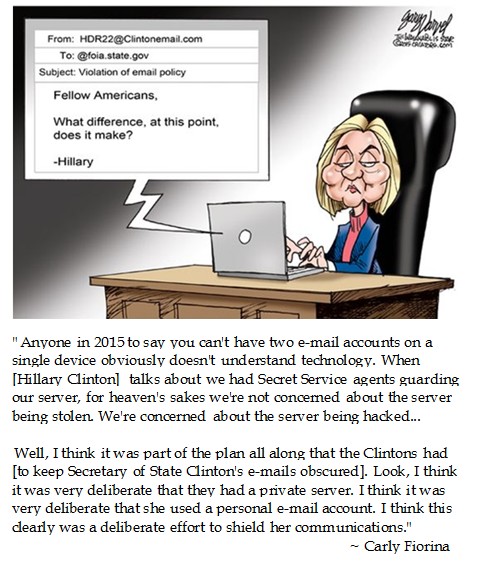
Considering the Clinton Emails "What difference, at this point, does it make?"
MSNBC's Ed Schultz excused Hillary Clinton as being technologically challenged for not understanding that a person can have two email accounts on one device. Perhaps, but not exactly someone who confidently took the bridge to the Twenty First Century.
But the Clintons' insistence on exclusively relying upon private servers for State Department business which are conveniently wiped clean when under federal scrutiny allows inquiring minds to wonder what electronic communications were being shielded.
Wednesday, February 25, 2015
Monday, January 12, 2015
Subscribe to:
Posts (Atom)