
Some consider the Nation’s Capital as “Fantasyland on the Potomac”. Other outsiders are “Fed Up” with the Federal City. It's better to consider D.C. as “the District of Calamity” (sic).
Showing posts with label Marco Rubio. Show all posts
Showing posts with label Marco Rubio. Show all posts
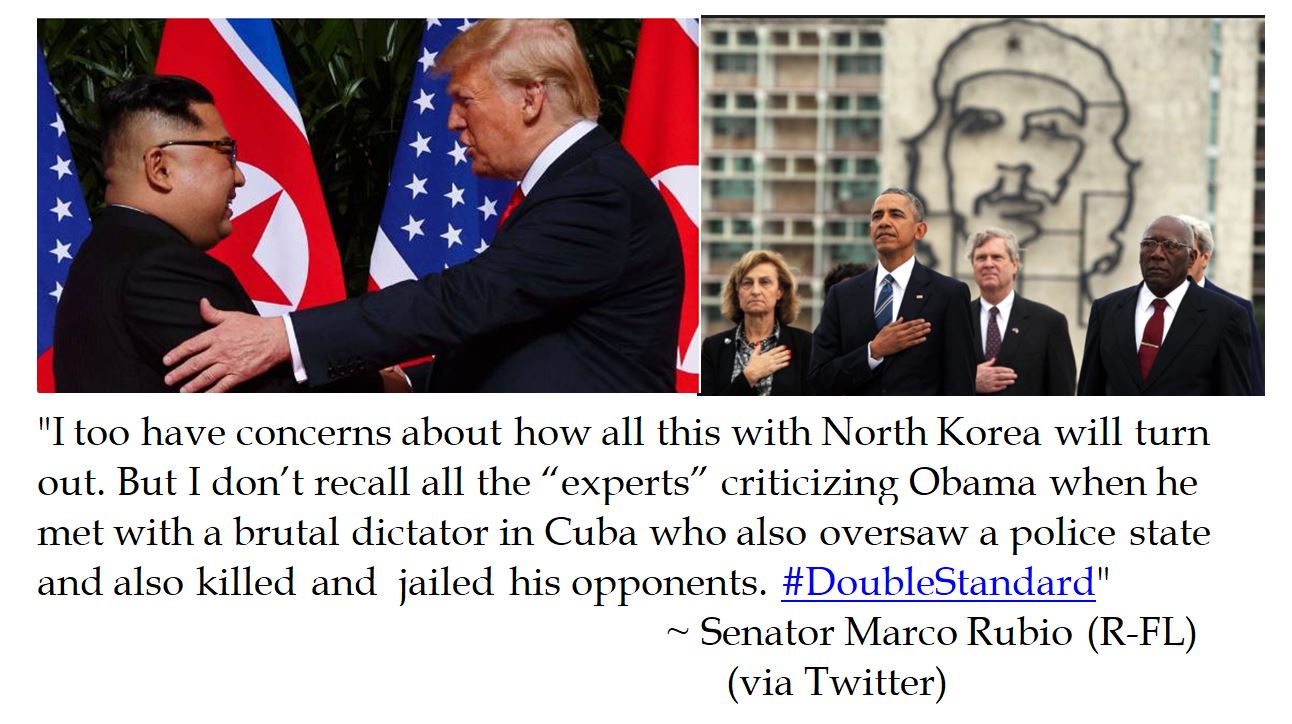
Tuesday, June 12, 2018

Wednesday, March 16, 2016

Tuesday, March 15, 2016
Marco Rubio on the Politics of Resentment

As Senator Marco Rubio (R-FL) made what was perhaps the hardest speech of his life as he withdrew from the 2016 Republican Presidential nomination race, Rubio was gracious, faith filled and philosophical.
Wednesday, March 9, 2016
Chary Cocktail Party Considers Cruz as Countermeasure to Trump
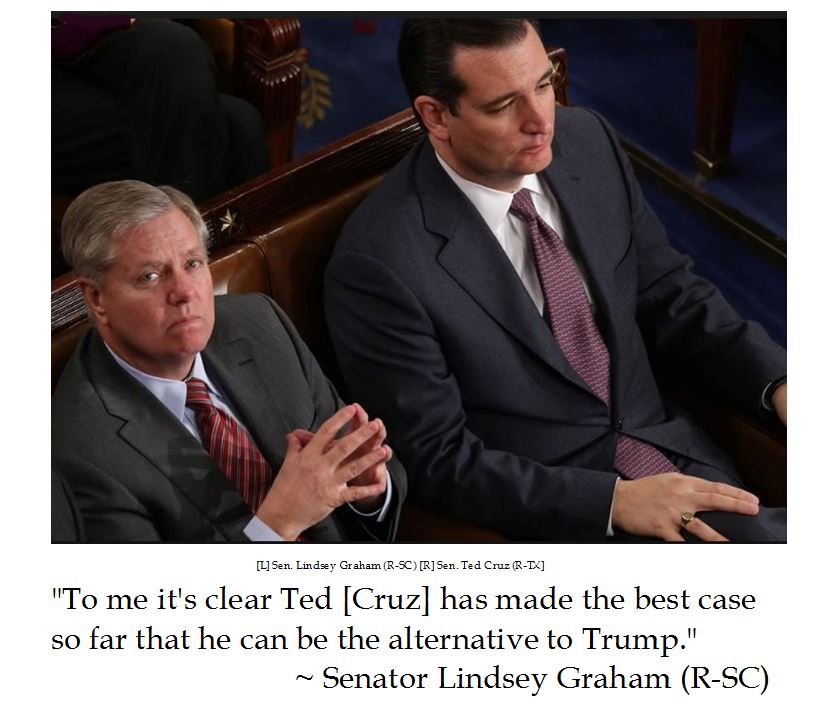
Senator Lindsey Graham (R-SC) is an Establishment Republican who dropped out of the 2016 Republican Presidential nomination race for lack of support. Still, Graham strives to play kingmaker for the nomination.
First, Lindsey Graham endorsed ex Governor Jeb Bush (R-FL) to little avail in New Hampshire or even Graham's home state of South Carolina. Jeb! dropped out after his disappointing fourth place finish in the Palmetto State.
Afterwards, Graham tried to ply his comedic charm to sway voters in the GOP primary process, by grossly joking that his fellow Senator Ted Cruz (R-TX) is so unpopular on Capitol Hill that someone could kill him on the Senate floor and there would be no convictions.
But now that Donald Trump is threatening to be victorious in the Republican nomination race, Establishment Republicans are looking for an alternative to Trump. Thus the GOP-e has desultory jumped from Jeb to Marco and Kasich to little avail.
Now Senator Graham has been charily campaigning on behalf of Senator Cruz as an alternative to Trump. In Graham's estimation, Cruz ought to pair up with Senator Marco Rubio (R-FL) as a unity ticket.
Of course, after Rubio cratering in the March 8th primaries, in which he came in last place in all four contests and netted scant candidates, this may no longer be viable.
It is ironic that DC Establishment types are now touting anti-Establishment candidate Cruz, the between the beltways Cocktail Party has a Damaclesian choice, and in his mind Graham is opting for the devil he knows rather than the devil he does not know.
Saturday, March 5, 2016
Marco Rubio on Being a Conservative
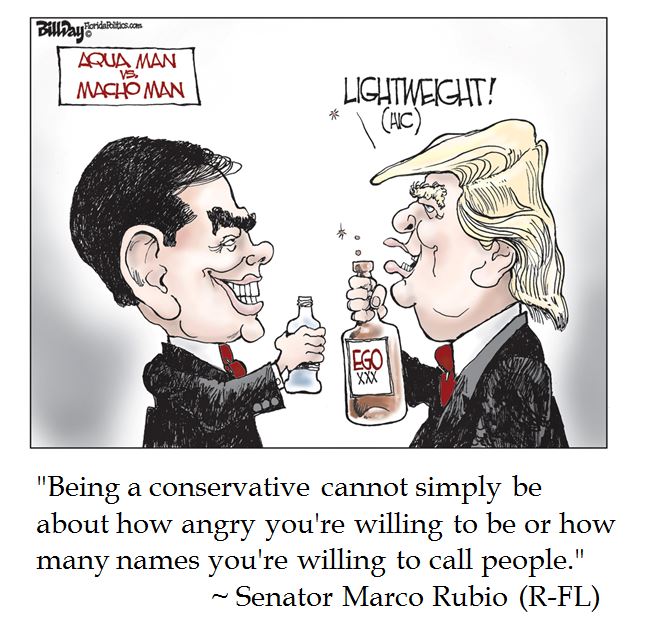
During his speech at CPAC 2016, Senator Marco Rubio took a veiled shot at his chief nemesis, GOP Presidential front-runner Donald Trump.
Rubio is seeking to distinguish conservatism from angry populism in the Republican Party. But this high minded oratory is a marked contrast to his humorous hits on the hustings last week.
Monday, February 22, 2016
Lindsey Graham Crackers on a Potent GOP Ticket

Senator Lindsey Graham (R-SC), a 2016 Republican Presidential who dropped out before the first ballot was cast, is again trying to play king-maker. Graham's ignominious exit from the race in December paved the way for establishment Republicans, to back former Governor Jeb Bush in New Hampshire and South Carolina. Graham's endorsement of Jeb did not hold sway in the Palmetto State Primary and Jeb honorably dropped out of the race.
Nonetheless, Graham fancies that there might be a potent Republican ticket by cobbling together Governor John Kasich (R-OH) and Senator Marco Rubio (R-FL). Kasich did come in second in the New Hampshire primary, primarily by practically moving to the Granite State and holding 100 town hall meetings. Rubio came in third in Iowa, fourth in New Hampshire, and was basically tied for second in South Carolina with Senator Ted Cruz (R-TX).
Graham's modest proposal epitomizes the Republican establishments animus against Donald Trump and their thinking on how to win over an angry electorate, by heralding two candidates who project a nice guy image and whose records incorporate some centrist tendencies (like Rubio on Gang of Eight immigration compromises and Kasich on Obamacare accommodations).
It would be interesting to see if Graham's proposed dream team are able to win their home state's of Florida and Ohio for the winner take all primaries on March 15th. As it stands today, it is dreaming an impossible dream for both proposed potentates. Graham's prognostication serves as a reminder that he was raised above a liquor store.
On Earned Media and Enabling

Campaigns must be able to spread the word about their campaigns when doing wholesale politics. Thus campaigns must either buy media spots (paid media) or generate free media coverage (earned media). This may be accomplished from a spectacular campaign event, an unusual comment which is considered "newsworthy" or from media hits.
The 2016 Republican field has used different media strategies to varying effect. For example, former Governor Jeb Bush (R-FL) and his independent (but sympathetic) Right to Rise Super-PAC gathered a huge war chest to sway voters. The Jeb! strategy was to earn legitimacy in Republican voters eyes by amassing a cornucopia of endorsements and shape the field by flooding the airways with paid media.
Obviously, this strategy did not work out well for the Bush scion. Pointing to a score of retired generals who endorsed Jeb did not prove to have much sway. Some of the name endorsements, like former Senator Bob Dole (R-KS) really seemed dated. And Jeb bringing out his mother and former President brother in South Carolina smacked of desperation. This was too little too late and did not generate significant (or particularly positive) earned media
More telling was the money that Jeb and the Right to Rise Super-PAC burned through tens of millions of dollars on paid media. The Jeb campaign and Right to Rise flooded the airwaves in Iowa, New Hampshire and South Carolina but Bush fell in towards the back of the pack and suspended his campaign early in the voting.
The Washington Post published a telling graphic to illustrate the cost benefit of Republican Primary campaigns on paid media and actual votes.

The only campaign which spent more per vote than Jeb Bush did is Dr. Ben Carson. But as Carson Campaign's Business Manager (tellingly NOT a Campaign Manager) Armstrong Williams knows, branding can be quite expensive. But it can also be lucrative for those charged with placing the ads. Bush confidant Mike Murphy worked at the Jeb oriented Right to Rise Super-PAC but reportedly earned $14 million for buying the earned media. Nice job if you can get it.
On the other end of the campaign publicity spectrum, there is earned media. Capitalizing on earned media has been one of the keys of Donald Trump's current success in the 2016 Republican Presidential Primary race. Donald Trump has been a master creating controversy to keep the spotlight focused on him and earning lots of earned media. During the summer of 2015, Trump received saturation media coverage by the networks. Trump's experience doing reality television already established name recognition and a branding of successful businessman in the eyes of many non-political low information voters. By saying outrageous things and constantly attacking opponents who threaten his perch, Trump generates tons of earned media.
Another characteristic of the 2016 Trump campaign is a persistent attack on the media. Trump complains seemingly whenever a media organization reports something critical. Trump will label them nasty, unfair or stupid. Trump has gone so far to eject credentialed media with whom Trump does not like the line of their questions.
Trump has a trend of disparaging journalists who challenge him, from benign interviews with Katy Tor to hostile news conference exchanges with Jorge Ramos. Most famously, Donald Trump launched myriad mysogenic slurs against Megyn Kelly, a Fox News anchor who questioned how Trump treated women. Several months later, Trump claimed that he was boycotting Fox News debates because of Megyn Kelly's inclusion, but later relented when Trump discovered that missing debates could hurt him amongst the electorate. To be fair, it might also have been a Trump technique of truthful hyperbole to further self promotion.
The attack dog mentality plays well for the angry electorate but Trump's tirades against Fox News seem somewhat counter-intuitive. Fox News has long been considered the major media outlet most friendly to Republican voices. Despite what Trump-eteers trumpet on social media, much of Fox News is friendly towards Donald Trump. Trump has long done weekly call ins with Fox & Friends. Judge Janine Pirro has a longstanding friendship with Trump and has formally endorsed him. In addition, Sean Hannity is a personal friend, as is Bill O'Reilly. Both are happy to give the Manhattan mogul airtime, but these shows do not necessarily endorse the candidate, although O'Reilly was obsequious in begging Trump to participate in debates (even promising to take milkshakes off the ledger).

So why does Trump peseverate on complaining about Fox News? The answer may be several fold. Trump loves positive news stories about himself. Despite all of the earned media, news hooks and friendly airtime through the auspices of Fox News, Trump has not won over Megyn Kelly thus he feels justified to rail against Fox. Cynically, Trump might deduce that attacking Trump may appeal to his "silent majority" of blue collar (Reagan) Democrats that are poised to support a populist like Trump but their perspectives have been poisoned by constant Democrat lambasting of Fox News. From a Machiavellian mode, by intimidating a strong opponent, it sends a bully message to the rest of the media and harbors a hint that they might lose access if they do not say nice things about Trump.
For running a comparatively shoe-string budget campaign, Trump has done well trading on celebrity, controversy and earned media access. Cable channels love to run with Trump quips because they attract eyeballs and create controversy, which improves ratings. Trump tends to speak unscripted, so you never know what he is going to say. As many campaign rallies have been at large venues, live media coverage can be justified as being newsworthy. Trump is not shy about doing interviews with those he can rely upon not to be hostile interviews, so he gets lots of airtime.
It is a curiosity that progressive channels like MSNBC and CNN have also been Trump obsessed. Is it because it is newsworthy? Does it attract eyeballs? Or could it be media manipulation to help pick the Republican nominee who will be easiest for a progressive to beat? Enabling through earned media isn't always an endorsement.

Some might conclude that Trump is brilliant in leveraging earned media to his advantage in the 2016 Election. But glowing coverage and earned media can only get a candidate so far. And those who live by the media can perish by the media. Senator John McCain had such a chummy relationship with the media on his Straight Talk Express, but the media mob turned on him after he won the 2008 Republican nomination. NBC News has bought all of the footage from Selena Scott's BBC documentary on Donald Trump but is holding the damning information until after the convention. The Lamestream Media has not focused on some of the business connections of the real estate tycoon.
Unless the Republican electorate is convinced that it is a Trump landslide, it is difficult to see how an earned media oriented strategy works to appeal in nine separate primary races during the so called SEC primary on March 1st. Then on March 15th, there are several big winner take all states in Florida, Ohio and Illinois which have many media markets and are not built for quick barnstorming campaigns.
But Trump is not the only seriously competitive candidate in the Republican nomination race. Senator Marco Rubio (R-FL) campaign relies heavily on endorsements and paid media. Rubio and his independent (but aligned) Conservative Solutions Super-PAC had amassed a vast war chest. Moreover, Senator Ted Cruz (R-TX) and his four independent (but aligned) Keep the Promise Super-PACs have raised lots of money and have been have resisted the temptation to blow the war chest early. This paid media, combined with strategic earned media news hooks and organized Get Out the Vote drives, could deflate the Trump balloon.
Trump is short on specifics but loves to taut his poll ratings and his greatness on media availability, might not look as promising for earned media if the so called Trump Train is slowed down. For example, Donald Trump accepted his second place finish in the Iowa Caucus' gracefully and did not use social media much the next day. Consequently, Trump disappeared from the media spotlight. The next day, Trump cranked up the smear machine questioning Cruz's eligibility and other outrageous claims that Carson had votes stolen from him during the Iowa Caucus. That media circus strategy works well for Trump when everyone is concentrating on the next state. But when there are many simultaneous contests in diverse regions, that might not be a successful strategy, especially if the media (or the establishment) has anointed the new "golden boy" for saturation coverage.
Looking forward to the General Election, once the Republican nomination is decided, even friendly foils in the media become fierce foes. This is to maintain impartiality, to create controversy to become newsworthy and often reflects the liberal Lamesteam Media bias. If a candidate is overly reliant on earned media from chaos campaigning and chummy Manhattan media ties, it could endanger the viability of such a candidacy. Oppo research leaks to the media about a candidate's shortcomings (or even silly stuff like crating a dog on top of a station wagon for a summer vacation) can dominate the media landscape and besmirch the reputation of a former media darling. While such jaundiced journalism would not alienate the hardened core of Trump supporters, it would bolster the ceiling of popularity and drive the debate to terra incognita.
Tuesday, February 16, 2016
Parsing Political Polling

In the 2016 Election Cycle, the Republican Presidential Primary has been driven by plethora of political polls. In fact, Donald Trump regularly trumpets his lead in “all the polls”. Yet Trump was surprised when he underperformed in the Iowa Caucuses, which has prompted bizarre tangents that the Manhattan Mogul really should have won the contest.
To try to educate enthusiastic but unsophisticated political partisans, here are some things to look for when considering the merits of polls.
Internet polls are unreliable. If this were not the case, former Representative RON Paul (R-TX 14th & 22nd) would have been the GOP nominee in 2008 and 2012 based on Internet Polling. There is no sampling, nor fail-safe ways to prevent over-voting. Internet polls do give an indication of social media enthusiasm, but this can be gamed and is not indicative of real grassroots support.
For the primaries, national polls are misleading as they mainly give a gauge of name recognition. If a candidate is well known, such as Hillary Clinton (D-NY) for the Democrats or Donald Trump competing in the Republican primaries, national polls can seem skewed towards them.
Given this reality, such candidates may craft their message to be one of inevitability. This pitch can be a perception that the nomination process is a coronation or that the leader in the national polls will sweep the table.
There are some sources, such as Real Clear Politics, which will combine polls to give a national average. This can give some indication about movements by candidates, but since this merges different methodologies, it is dangerous to rely upon the specific numbers.
In our system, however, states hold primaries. These states have different primary electorates, and often vote on different dates so candidates’ messages are often tailored to appeal (perhaps pandering) to particular audiences. For example, Ohio Governor John Kasich started to drop his “n”s in and be downhome in evangelical appeal at the last South Carolina primary. Sometimes this strategy works, but it can come off as unctuous and inauthentic.
While state polls can be more illuminating, there are still lots of details one must discern in the cross tabs. Most casual consumers of campaign news only listen for the top line results, either the pecking order or the purported percentage of support. The crosstabs involve the margin of error.

For example, this CBS GOP bar graph for the South Carolina polling has a Margin of Error (MOE) of 5.7%. A useful rule of thumb is that ANY poll with a Margin of Error of more than 5% is practically meaningless. In this instance, Senator Ted Cruz could have 25.7% support or as little as 14.3%. Senator Marco Rubio (R-FL) could vault into second with up to 20.7% or drop into a tie for fourth place at 9.3%. That large range makes most of the pecking order suspect.
Then there is the question of who makes up the body of those who are polled. Asking any American is dubious for primaries as most of those contests are closed. So if a poll’s sample is skewed 80% Democrats for a Republican primary, the results will be apple-sauce. A slightly more reliable class is registered voters, but without separating party affiliation, this will still be suspect. The gold standard is likely voters for a given party.
In order to find a pool of likely voters, pollsters will ask vetting questions to ensure that the surveyed voter has cast ballots in several past elections. This takes time and costs the pollster money, but is much more reliable than something like an internet poll with trolls clicking out of their parents’ basement.
Polling is both an art and a science. The pollster needs to predict what is the right turnout model for an election. Grassroots Republicans are more likely to turn out in off-year elections. There were extraordinary turnouts of new voters and African American voters who turned out for President Barack Obama in 2008 and 2012. Will the same numbers of voters return in elections where Mr. Obama is not standing? It can be a major mistake for pollsters to use the wrong model when predicting elections
Determining the right sample is imperative and may explain the disparity between the polls and the Iowa Caucus results. Prior to the Hawkeye Cauci, it was postulated that Trump needed to turn out a large swell of new participants to the caucus. The Trump campaign did not concentrate on Get Out the Vote efforts. Nevertheless, there was a large contingent of “new voters”, but the new voters were disinclined to support Trump.
Public polls are only news if a news source determines that it is fit to print and advances their narrative. Some news sources have sat on poll results which do not augment their desired narrative, or they will bury them with Friday afternoon releases or on the back pages.

It used to be Gallup that was the standard, but they seemingly have bowed out of election polls. But not every polling company is the same For instance, Public Policy Polling tends to be a Democrat operation. So their results may be crafted to make mischief for Republicans or have flawed methodology.
The manner which a prospective pollee is contacted may influence the results. It used to be that telephone polling was pretty reliable. However, now that many households have dropped land-lines, results including cell-phone callers can be questionable. When you call also matters. If pollsters will reach fewer Republicans at home during weekends, which may adversely affect the numbers. There is some thought that people are more likely to tell pollsters that they support Trump if it is an automated call rather than person to person.

Robo-call polls are not really meant to measure support for an election field but are the cover for push polling. In puah polls, if a voter indicates that they like candidate X, they may be told adverse information meant to dampen support for that candidate. Trump has been complaining about Cruz’s robo calls about Trump dropping out, but it seems like Trump is fulfilling that premise with insinuations that he might quit if the GOP does not treat him right.
Exit polls, which are conducted on election day, after a voter has casted his ballot, often are instructive in the eleventh hour. These exit polls can be off the mark if there is too small of a sample, if the chosen precincts are not representative of the electorate and the reality of some voters will not tell the whole truth to their interviewers. Exit polls give news organizations a heads up on probable election results before the polls close and facilitate in forecasting end of the evening winners. Aside from inquiring about the actual candidate, exit polls can be a barometer about what were the real hot button issues for voters and give the media something to talk about as the election returns start to come in.

It is unfortunate that in the 24/7 news cycle, many media sources will use horse race polls of dubious merit to fill their time and create excitement in the electorate. This can create false expectations by those who just scan the headlines.
There are internal polls which are commissioned by campaigns. These internal polls can give politicians a real reading of the electorate. These internal polls can also be enlisted to hone a message to find out what are hot button issues or what is a better way to couch a policy proposal. But these internal polls can also convey wishful thinking. When a campaign leaks an internal poll, they may be giving credible alternative information ignored by the drive-by media. Or it could be releasing agiprop to staunch waning support or to create a perception of a surge.
Instead of premising political support on the bandwagon effect, voters should make up their own minds and not be framed by the primary polls. The reality is that the only poll that counts is on Election Day. If the eventual winner of the primaries is not one’s cup of tea, other metrics may be called for in the General Election.
Monday, February 8, 2016

Sunday, February 7, 2016
Dealing with Glitches in the GOP Debate

Republican Presidential hopeful Senator Marco Rubio (R-FL)'s rapid rise in the primary political polls has been premised on strong debate performances. Rubio is articulate, some say smooth talking, in giving upbeat bite sized morsels during his time on the debate stage.
Rubio surprised many political observers by his showing at the Iowa Caucuses, where he came in third as expected, but only 1.5% behind second place finisher Donald Trump.Thus his rapid rise made him a prime target at the Republican Debate held three days before the New Hampshire Primary. So he should have known what to expect.
After seven prior Republican debates, astute observers know candidates' patterns of behavior. Ex Governor Mike Huckabee always slung "canned ham", hokey pre-written one line zingers designed to make him seem like the funny every-man's candidate. The Iowa Caucus echo of Adele "It's Me" was expected but still amusing. Donald Trump (when he deign to show up for a debate) will start being subdued but eventually with squabble with Jeb! Bush. Dr. Ben Carson will joke about how little time he is being allotted and will do a data dump on questions not posed to him.Governor John Kasich (R-OH) will wildly flail his hands when speaking at the podium with occasional karate chops for rhetorical punctuation.
Senator Rubio was wont to retell his family's remarkable American Dream story, which loses its effectiveness after it has been used a few times. Rubio also had the habit of asking people for their vote in a close, which gets a bit cloying. Wisely, Senator Rubio has dropped both tacts. As for style, Senator Rubio shoots for the American Dream in some responses and then tries to focus attacks on Obama and Hillary, while subtly shivving other candidates in the back. This approach has given Rubio great favorability ratings. Along with his strategy of heavy paid media campaign advertising, it has precipitated his top tier status.
Governor Christie is staking the fate of his entire campaign upon doing well (placing in the top troika) in the New Hampshire Primary. For the week before the Republican Debate in Manchester, Christie had been gunning to take Rubio down a couple of notches, deriding him as "Bubble Boy", who was not accessible to voters or responding to tough questions. Other have ripped Rubio as being robotic. So the critiques were being telegraphed to Rubio. Yet the freshman Florida Senator displayed a glaring glitch.
It seems that Rubio got rattled after Christie repeatedly rubuked him for giving memorized 30 second speeches. Almost to prove his point, Rubio blurted out similar tracks about President Obama four times in four minutes. In post debate spin mode, Rubio claims that he is passionate about this position and wishes people would keep playing the clip. The episode inspired a parody Twitter account "Marco Rubio Glitch".

Unfortunately, that was not the only instance were over-preparation showed. In his answer about the military, Rubio began his answer, then stopped and began again because his memorized stump speech had to be delivered in that order. Again, this glitch contributes to the charge of being robotic and mars an otherwise good debate performance, with excellent responses about ISIS and defining conservativism.
I do not begrudge candidates doing preparation work prior to a debate. In fact, it shows some respect for an audience and hones a message, unlike Donald Trump's flippant definition of conservatism as "conserving money". However, it is most effective if the audience is unaware that you are prepared. For example, Huckabee's canned ham are groaners because you know there are not spontaneous and he stained to find the opening to launch the zinger.
Similarly, by regurgitating the same rhetoric several times in a short span sounds robotic and pre-programmed. Discerning viewers are prompted to question authenticity. It begs the question of how a candidate will stand stricter scrutiny in the General Election campaign.
Sometimes glitches underline growing perceptions. Ben Carson had developed a whiney reputation from the debates for not getting enough recognition or time allotments. The Carson campaign seized on a kerfluffle over a CNN news report at the start of the Iowa Caucuses that Carson was taking time from the campaign trail prior to the New Hampshire Pimary. Both the Cruz and Rubio campaigns spun this news to their grass-root leaders in the Caucuses to garner more votes. Carson took umbrage exclusively at Senator Ted Cruz (R-TX). Cruz quickly apologized for not passing along subsequent reports. Carson claimed as a Christian he accepted the apology but then priggishly seemed to require conditional forgiveness. Cruz apologized again at the Manchester Debate, but that did not seem to assuage Dr. Carson's animus.
But as the candidates were being introduced onstage at the Manchester Debate, there was a technical glitch to cue Dr. Carson so he remained waiting in the wings, even as a stage manager gestured for him to take his place. The ABC News Moderator David Muir had to invite Ben Carson for him to go to his podium. Afterwards, Carson complained about not being introduced second.
This strange stagecraft, combined with a perception of priggish prissiness in politics, made it seem like Carson was being stand-offish because of a pecking order failure. Along with Carson's standard complaint about being ignored and his refusal to accept Cruz's repeated apology, it gave a bad impression. The technical glitch may have be inadvertent, but the cascade of a candidate who stands on heirs and hardly seems like he is working to win was a tough impression to shake.
 Most of the time, people do not remember the substance of a debate but their impressions. Famously, in the 1960 Presidential Debate, the radio audience thought that then Vice President Richard Nixon (R-CA) bested then Senator John Kennedy (D-MA). But the vast majority of the audience was on television, and they remember Nixon's five o'clock shadow vis-a-vis a tan, rested and telegenic Kennedy.
In the 1980 Republican New Hampshire scheduled with then George H.W. Bush one on one debate, all people remember is then former Governor Ronald Reagan (R-CA) saying: "Mr. Dean [editor's note- which was actually the wrong name], I paid for that microphone." It showed assertiveness and authority.

Or the 1992 Richmond Town Hall debate when President George H.W. Bush was caught on camera looking at his watch. It gave the perception that Bush looked bored.
Then there was Vice President Al Gore's audible sighs in the 2000 Debate, which in retrospect he may have wanted to keep in a lock box.
How much the Rubio Glitch or the Carson miscue sticks in the minds of Granite State primary voters remains to be seen. At the very least, Rubio's less than stellar Manchester debate performance has halted his meteoric rise in the media and may prompt another antagonizing reappraisal by the GOP establishment of which horse to back against insurgent outsider candidates.
Thursday, February 4, 2016
More Muddled Message From Ben Carson

The Ben Carson campaign has been capitalizing on a kerfluffle regarding a CNN report just as the Iowa Caucuses were starting that Carson was suspending his campaign. Other opponents, such as the Cruz and Rubio campaign, trumpeted the information to their grassroots operatives. A subsequent clarification from the Carson campaign that he was off the campaign trail for a few days to get some R&R as well as fresh clothes, were not passed along to the Caucus precinct captains.
Senator Ted Cruz (R-TX) publicly apologized for not passing along the additional information. Some have been scandalized by a recorded telephone call (isn't dissemination a felony unless there's two party consent?) that the Cruz campaign pushed a suspended campaign pitch to win over Carson voters.
Dr. Carson has perseverated on this point. First, he claimed Christianity forced him to accept the apology but then his forgiveness was conditional. Then his expectation evolved to having heads roll in the Cruz campaign. Now in day three of this contrived controversy, Dr. Carson went on television to demand:"Don't do what's legal, but what's right". Whatever does that mean in the primary process?
In addition, is this selective outrage? The Rubio campaign was also trafficking in this report. Why is Cruz the sole focus? Is it animus against Cruz because some of his New Hampshire staff and fund-raisers defected to Cruz? Is it because both Cruz and Carson are competing for the same sliver of the Republican primary electorate? Or is it to gang up on the front runner which neither the establishment nor the press likes?
That pious platitude is about as clear as Carson's campaign clarification that he was leaving the campaign trail to get fresh clothes in the heat of a primary that could determine the viability of the Carson campaign.
It is unclear what Carson really wants, other than more publicity and burnishing his personal brand. Perhaps he will answer when he returns to New Hampshire on Saturday afternoon for the Republican Debate. But if he thinks that this whiny, ambiguous complaints about past contests endears himself to conservatives, he is as mistaken as former Governor Sarah Palin was about her endorsement of Donald Trump for President
Sunday, January 31, 2016
One Day More to the Iowa Caucuses

One day more until the Iowa Caucuses. It will be good to have voters start actually participating in the primary process rather than hype the horse-race based on sketchy scouting reports.
 Donald Trump is the presumptive front-runner. He is always anxious to point to the polls and his huuuge crowds. Trump scored a couple of prominent endorsers, including former Governor Sarah Palin (R-AK) and Jerry Falwell, Jr. Trump was also aided by left handed compliments from current Governor Terry Branstad (R-IA), who is anxious to bolster ethanol mandates.
Trump eschewed the only Iowa debate supposedly because of a tiff with Fox News and Megyn Kelly. But Trump’s post-debate excited utterances at how Trump was glad to have missed the pummeling questions may be an admission against interest. Iowa voters expect to be courted and this cycle have remain undecided until the last minute. Will the Manhattan mogul’s reticence towards Iowa retail politics hurt him in the caucuses or will it be another one of many things his fanatics will forgive him?
Time will tell if celebrity campaigning draws in many first time caucus goers. In the 2012 cycle, only 125,000 people parcipated in the GOP Iowa Caucus. Patrick Murphy, the director of Mamouth University’s Polling Institute, opined: Trump’s victory hinges on having a high number of self-motivated, lone wolf caucus-goers show up Monday night.”. Add in the factor that many Trump-eteers are non-traditional first time caucus goers who have to be trained, motivated and ripe to turn out in Iowa, not just through social media or at a rally. If 150,000 or more Republicans actually participate (rather than just register) in this year’s Hawkeye Cauci, then it will be a good night for Trump.
 Senator Ted Cruz (R-TX) established an excellent ground game in Iowa while making pointed appeals to evangelical voters and Tea Party types (under the banner of being a consistent Conservative). Cruz claims to have 12,000 volunteers in Iowa. Even political operatives who do not support Cruz, such as Alex Castellanos, concede that Cruz has established a formidable social media operation.
Organization is key to driving caucus goers to the polls. Sometimes campaigns must literally drive their supporters there. Also having representative to speak at each caucus To aid in the retail campaigning, they rented college former dormitories and dubbed them “Camp Cruz” to house hundreds of door knocking volunteers. There has been some controversy over an 11th hour targeted voter mailer from the Cruz campaign which was intended to shame people into caucusing. Cruz dismisses such complaints claiming that the mailer was routine and he favored using every tool to get voters out to the Iowa Caucuses
Rather than pander to Iowa voters, Cruz advocated the elimination of ethanol mandates, and compromised by phasing them out over five years. But Cruz’ opponents and those supporting the ethanol lobby labeled that a “flip-flop”.
Cruz did score some significant endorsements for Iowans, including Tea Party favorite Representative Steve King (R-IA 4th), former Governor Rick Perry (R-TX), evangelical leaders Bob van der Plaats, and Tony Perkins, Duck Dynasty Commander Phil Robertson and radio personality Glenn Beck.
Cruz has barnstormed the Hawkeye State. By the time the caucuses start, Cruz claims that he will have done the full Grassley (referring to Iowa Republican Senator Charles Grassley) by having events in all 99 Iowa counties. This type of retail politics was rewarded in 2012, when former Senator Rick Santorum (R-PA) won a narrow victory against former Governor Mitt Romney (R-MA). The Cruz campaign has also outreached to twice the number of likely caucus-goers than Trump.
However, since Cruz rose towards the top of the Iowa polls in mid-December, he has been targeted by Trump over dubious “birther” (and now even “anchor baby”) attacks. Of late, Senator Marco Rubio (R-FL) has been joining the fray to claim that Cruz is running a “disingenuous” campaign. This has lead some political observers to conclude that Cruz peaked too early.
As the Iowa Caucuses approached, Cruz closed warning crowd of the dangers of voting for Trump and jabbed at Senator Marco Rubio (R-FL). This may evidence a lack of confidence of decisively winning the Iowa Caucuses as planned. However, weather forecasts project a major snowstorm starting just before the Caucus begin. While Haweyes are heartier than denizens in the District of Calamity, a lower turnout may be the key to victory for Cruz, as his organization gets dedicated supporters to turn out on a snowy February evening.
 Senator Marco Rubio has been coming on strong in Iowa, seemingly from good debate performances and wholesale politics via the airwaves. The Rubio campaign bet on de-emphasizing boots on the ground campaigning. In fact, Rubio deputy campaign manager Rich Beeson proclaimed: "The days of having to have 50 field staffers and 25 offices are done. We can have a field office and staff set up in a Starbucks with wireless and get just as much done as we can in a brick-and-mortar office with land lines." Perhaps. But does that compensate for the paucity of events in Iowa?
 Rubio’s Super PAC ran half hour informercials on the Saturday night before the Caucuses on 12 TV stations in five media markets. Will this work or just be noise as one flips channels on a Saturday night?
It would seem that Rubio is positioning himself for the third ticket out of Iowa, as the Caucuses tend to winnow the top tier winners from the campaign chaff. The strategy would be to frame the media story to be the Comeback Kid who comes out of no-where.
Iowa should have been the ideal launchpad for the Presidential aspiration of Dr. Ben Carson, as a Constitutional Conservative to appeal to Tea Partiers and a man of strong faith to appeal to evangelical voters, who make up 45% of Republican caucus goers. But Dr. Carson’s campaign has precipitously receded since being in the number two chair for the early December GOP debate. For the Iowa Debate, Carson only was allotted six minutes.
The Carson campaign has been bleeding top advisors for the last month in the run up to the Iowa Caucuses. Carson himself has admitted that if he does not do well in Iowa or New Hampshire that he might have to do an agonizing reappraisal. Senator Rand Paul’s (R-KY) campaign brags that they have 1,000 libertarian leaning collegiate supporters. If they turn out to the Caucuses, that might help lift Paul’s campaign from the primary doldrums. But if Dr. Carson were to be edged out of fourth place in Iowa by a surprise surge from Governor Chris Christie (R-NJ) or Senator Rand Paul , discernment time might come sooner.
As counter-programming to the Republican Debate which Donald Trump boycotted, he held an event to help veterans and wounded warriors, which raised $6 million for largess via the Donald J. Tump Foundation. Also appearing at the Trump for the Troops event were the two prior winners of the Iowa Caucuses former Sen. Rick Santorum (2012) and former Governor Mike Huckabee (R-AR). Both claimed that they wanted to support veterans but Santorum was more candid as he had nothing to do after participating in the under-card debate.
 |
| [L] Ex Sen. Rick Santorum (R-PA), [C] Donald Trump {R] Ex. Gov. Mike Huckabee |
Cynics see auditions to a prospective Trump Administration thus they seem like vassals for The Donald. Is it telling that Donald Trump will give his post Iowa Caucus “winning” speech in Little Rock, Arkansas.
It will be interesting to see how Big Mo goes after the Iowa Caucuses. Typically, the top three candidates get a rush of publicity and funding after Iowa. But Big Mo does not always translate into winning the next contest, as New Hampshire primary voters are contrarian. In the 2016 cycle, Trump is comfortably in the lead and Governor John Kasich (R-OH) is surging into second in the Granite State.
In this cycle, some campaigns have raised significant campaign contributions so they are unlikely to quickly fold after Iowa. Former Governor Jeb Bush (R-FL) seems resigned to garner better showings after Iowa and New Hampshire and Jeb!'s campaign has the money to make it there. Rubio’s campaign is well funded and can survive not winning in the Caucuses or the First in the Nation primary. Cruz has been conservative in spending his large campaign coffers and will probably concentrate on South Carolina and the SEC primaries on March 1st.
With all of this attention on the Grand Old Party, it is easy to overlook the Democrats. It is expected that 140,000 Hawkeye Democrats will participate in the Caucus and they skew very white and liberal. It would not be surprising if Senator Bernie Sanders (Socialist- VT) won both the Iowa and New Hampshire contests. Pro arguendo, Sanders momentum combined with the maelstrom of the Clinton Email Scandal, might cause the Democrat establishment to scramble for substitutes instead of the Hillary coronation, akin to 2004 after the Dean scream.
The fun begins in earnest on February 1st.
Friday, January 22, 2016

Friday, January 15, 2016

Monday, December 21, 2015
Why Graham's Gone
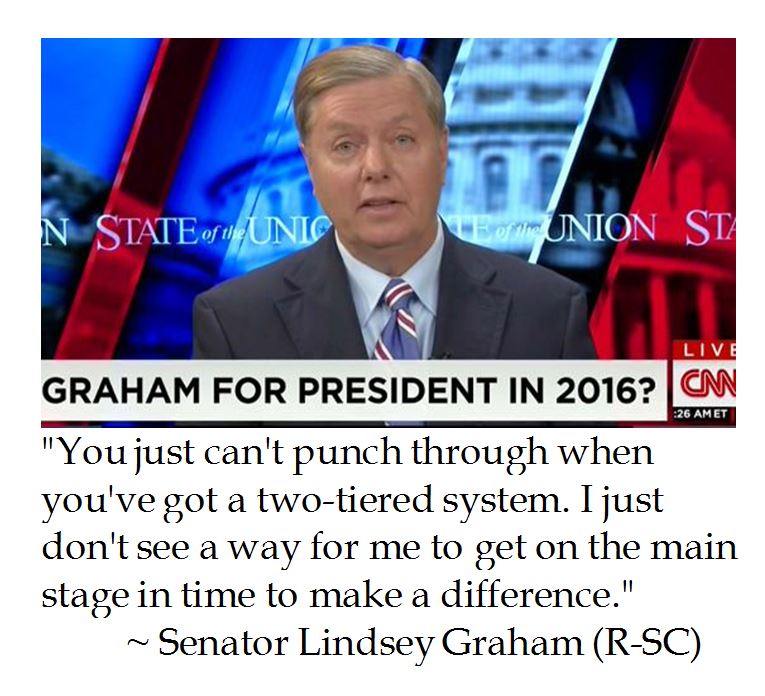
December 21st was the last day for filing to be on the 2016 South Carolina Republican Presidential Primary ballot. It is no coincidence that it was the same day the Senator Lindsey Graham dropped his quixotic campaign to be the GOP POTUS nominee.
Aside from absorbing accolades from the press corps in several of the under-card Republican debates, Lindsey Graham has been a non-entity in the Republican Presidential Campaign. The only place in which he excelled was consistently coming in last place all year in The Blaze's monthly Presidential Preferences among Glenn Beck listeners.
It is questionable if Senator Graham ever had a realistic pathway to primary victory in the GOP. His best hope would have been to win as a favorite son in South Carolina and parlay primacy in the Palmetto State into Big Momentum going in the nine SEC primaries the week afterwards. At that point Graham might have held some sway with delegates if there was an open Republican convention in Cleveland. Still those were pretty impossible dreams.
Alas, Graham only garnered 0.5% in most national polls and perhaps 4% in his home state of South Carolina. Graham presumably did not want to be thought of like Gov. John Connolly (D/R-TX) who famously spent $10 million to win 1 delegate in South Carolina during the 1980 cycle.
Even though Graham won re-election to his third term in South Carolina in 2014, a colossal failure on the Presidential Primary stage might be a memory which loomed large in a state where he was considered a weak incumbent and only took 55% in the 2014 General Election.
Aside from ego, Graham seemed initially driven to strengthen the American military, especially during a time of war. Some might suspect this issue oriented campaign was meant as a counterbalance to a more neo-isoloationism espoused by his libertarian Republican rival Senator Rand Paul (R-KY). However, Graham shifted to taunted Donald Trump from the small debate stage. He may calculate that his absence in the Republican field will allow his Senate sidekick, Senator John McCain (R-AZ) to make a more consequential endorsement for the New Hampshire primary, which McCain won in 2000 and 2008 so his word may carry some weight.
Besides, Graham's reputation for warning "We're at war" along with his 30 plus years service in the National Guard may make him a candidate to be Secretary of State in a prospective Jeb! or maybe Marco Rubio administration, particularly if the Graham endorsement is timely and effective.
Wednesday, December 16, 2015

Friday, October 30, 2015
Jeb! Campaign Blueprint--Phileas Fogg or Baron Munchausen?

Jeb Bush’s Campaign staff shared with US News a 112 page internal campaign blueprint that exposed the the nitty gritty details of an establishment $130 million primary campaign. After studying the Jeb! Q3 Campaign Briefing, it is hard not to hear the candidate speak and not think of the strategerie (sic) behind it. Yet the opposition intelligence contained in the blue book used to buttress its analysis also lends insight on the possible perceived primary pathways to victory for much of the Republican field
Jeb’s campaign is banking on surviving the February GOP contests. Afterwards it would leverage its fundraising prowess (both hard money and Super PACs) via advertising, endorsements, strategic Hispanic outreach for success in many contests. The Jeb! campaign is comfortable selling an idea of inevitability that Jeb is the only one electable against Hillary Clinton for a Game of Thrones dynastic grudge match.

 It was telling that the Jeb! campaign advisers used a literary conceit to explore their long term primary strategy. After the early primaries, the Jeb! campaign used the codename Phileas Fogg, from Jules Verne’s Around the World in 80 Days, to liken the frenetic March strategy to compete for 1,428 delegates in 22 state contests.
 The character Phileas Fogg was a wealthy gentleman living in solitude but in a meticulous manner who takes up an impossible bet at the Reform Club. Around the World in Eighty Days chronicled those adventures. Kind of curious parallels when applied to a campaign of a son of a wealthy dynastic political family who had been away from politics for years but plots to come back with a well crafted plan. Hmm.
While the internal memo did have several graphics which grappled with the Donald Trump phenomenon (particularly on the “W” association that he kept us safe), it seemed as if Jeb strategists perceived their main rival as being Senator Marco Rubio (R-FL). The Jeb! campaign is prepared to shill the line that “Rubio is a risky bet” and playing up political parallels with the career of Barack Obama. Hence the Jeb attendance attack on Rubio during the third GOP Presidential debate.
The fundraising bar graphs showed that Bush inspired organizations (like the Right to Rise PAC) being prepared to outspend Rubio inspired organizations (like the Conservative Solutions PAC) for Future Ad Buys in Iowa and New Hampshire. The Jeb! Campaign also was going to do a strong ad buy in South Carolina.
To extrapolate some strategy from the blueprint, Jeb is prepared to spend big in Iowa on the airwaves. While they have a paid staff of 7 which includes a Hispanic outreach team, one senses that they are not trying to win as much as not being winnowed out. The heavy ad buys in New Hampshire indicate this is where they would like their first win. However, winning the Granite State would be challenging as Governor Chris Christie (R-NJ) is putting everything in New Hampshire. This would also seem like fertile campaign territory for Donald Trump and Carly Fiorina. The proposed heavy ad buys in South Carolina would rely upon “Big Mo” from New Hampshire into parlayed success in the Palmetto State.
The curious aspect of this internal analysis is its ambiguity for the SEC primary. If Jeb is able to neutralize Rubio, he would have the inside track on Florida’s winner take all 99 delegates. Jeb’s appeal has promise in some of the bigger states, presuming that the field of 15 candidates is mostly cleared.
 The shortcomings of Jeb’s strategy are manifold. They seem to think endorsements are of utmost importance. In fact, their answer to foreign policy challenges is look at how many decorated general support Jeb. The Jeb strategists look kindly upon “the Bush brand” which seems counter to Bush fatigue and anti-dynastic ebbs in this election cycle. The Jeb strategists believe that pointing to Bush’s educational accomplishments as Governor nearly a decade ago is a selling point without addressing complaints about Jeb’s association (promotion and profiting) from Common Core.
From a meta standpoint, Jeb’s campaign revolves around big money, which is necessary for the saturation advertising for the Bush brand prior to the February contests. Well, events like disastrous debate appearance can stop the flow of funds. And because of the staffing and need to do early ads, their burn rate is about 90%. It may make it hard to grease the skids when crunch time comes. This might explain the course correction of slashing campaign costs and shaking up the campaign as Jeb languishes in low poll numbers nationally and in key early contest states.
Moreover, the internal analysis is ambiguous on their Phileas Fogg strategy for March. It’s great that there are a boatload of delegates available in March, but how exactly does one compete in twelve simultaneous contests on SEC Tuesday (March 1) for 612 delegates distributed proportionally. Surely the answer is with advertising dollars and “The Big Mo”. But GOP rules this cycle require “winning” at least six contests for a candidates name to be placed in nomination. Unless Big Mo is an avalanche, this might be a big problem for Jeb.
This is a crowded GOP primary field. Several candidates look like they have staying power based on big bank accounts which have not been burnt through (e.g. Trump, Cruz). It is an outsider’s election with Dr Ben Carson and Donald Trump in the lead, but a Jeb conceit that they will fade away and Rubio is the big challenge. The briefing focuses at winning delegates but not necessarily contests. This could be a fatal mistake as GOP primary rules require winning at least six contests for a name to get put into nomination. If the February primaries are divided by several contenders, there may neither be “the Big Mo” nor the establishment (electable) and outsider left as the last men standing. That scenario moots the blueprints findings.
This cynical political junkie is wondering if the Phineas Fogg blueprint would be better substituted by the Adventures of Baron Munchusen. It may be less of a frenetic but methodical slog as envisioned by the internal analysis and more of like on of the Munchausen movie tagline “Remarkable. Unbelievable. Impossible. And true.”

h/t: US News
Thursday, October 29, 2015
Senator Marco Rubio Answers Accusations About Senate Absenteeism
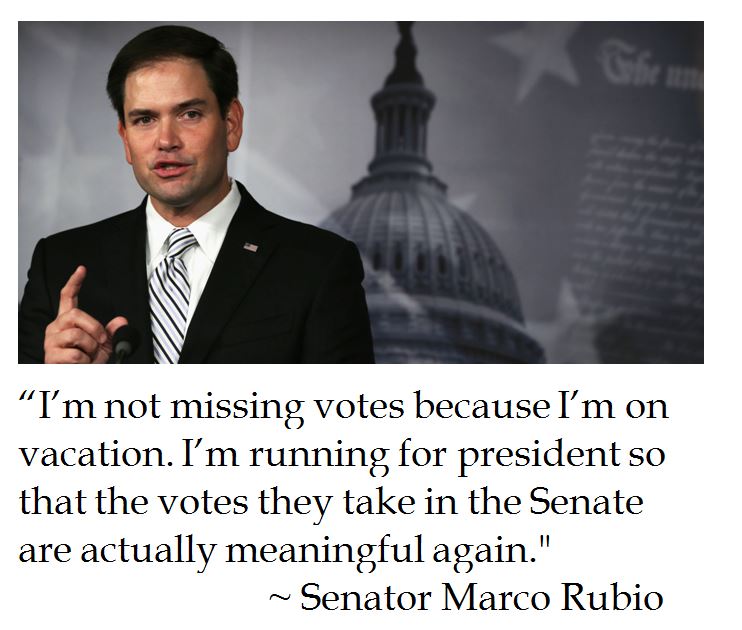
Freshman Senator Marco Rubio (R-FL) has not earned a gold star for attendance in his tenure in the Senate. Rubio's run for the White House has kept him away from some Senate votes, but even prior to hitting the campaign hustings, Senator Rubio had developed a reputation for being absent in the Senate.
On the eve of the CNBC GOP Debate, the South Florida Sun-Sentinel published an abrasive editorial demanding that Senator "Rubio should resign and not rip us off". Inevitably, this was going to be brought up during the debate.
Former Governor Jeb Bush (R-FL) seized the the opportunity of Rubio's spotty Senate attendance at the record to make headlines by attacking his fellow Floridian with canned attacks.
But Rubio had done his homework and anticipated the attack. Rubio rightly pointed out that during Senator Bob Graham's quixotic 2000 Presidential campaign that he missed 40% of the votes. Moreover, Senator John Kerry missed a super majority of Senate votes while being the 2004 Democrat nominee. When Rubio jabbed back at Jeb, he noted that Jeb was emulating McCain, who also missed many votes when running for President.
Even though Rubio was well prepared for the attack about absenteeism from the media and his electoral opponent, it did not sound too scripted or wooden. Rubio also made the first foray into attacking the liberal media bias, which came to fruition by Senator Ted Cruz (R-TX).
Tuesday, October 6, 2015
On Congressional Kabuki Show of Show Votes, Spending Sprees and Shutdowns

Last week, Majority Leader McConnell (R-KY) engineered passage of a Continuing Resolution to keep the government funded for the first two months of FY2016. To prevent the possibility of a shutdown due to riders which might derail cloture, McConnell borrowed a trick from his predecessor Senator Harry Reid (D-NV) and he "filled the tree" by precluding any such amendments to be considered thus a clean CR. This allowed the must pass legislation to easily achieve a 77-19 majority.
Republican Presidential hopeful Senator Ted Cruz (R-TX) was truly displeased with not being able to effectively attach a Defund Planned Parenthood Amendment on an otherwise clean CR. Cruz took to the Senate floor for an hour to educate the public about show votes, spending sprees and shutdown threats.
In today's Washington, there are three kinds of votes. There are, number one, show votes.. Votes that are brought up largely to placate the voters where the outcome is fore –ordained,, where most Republicans will vote one way, Democrats will vote the other, Republicans will lose, and the conservatives who elected Republican majorities in both houses are supposed to be thrilled that they have been patted on the head and given their show vote that was destined to lose. We had a vote like that in recent weeks on Planned Parenthood. Leadership told us: ‘You should be thrilled. We voted on it. What else do you want?’ We voted on it in a context where it would never happen. And indeed it didn't.The second kind of vote are votes that simply grow government, that dramatically expand spending, expand corporate welfare, and those votes, Mr. President, those votes pass. Because you get a bipartisan coalition of Republican leadership and Democrats, both of whom are convinced that career politicians will get reelected if they keep growing and growing government, and in particular, handing out corporate welfare to giant corporations. Oh, boy, if you’ve got the lobbyists on K street pushing for something, you can get 60, 70, 80 votes in this chamber because Republican leadership loves it, and Democrats are always willing to grow government.
And then there's a third kind of vote. Votes on must-pass legislation. In an era when one side, the Democratic Party, is adamantly committed to continuing down this path that is causing so many millions of Americans to hurt, must-pass votes are the only votes that have real consequence in this chamber. They typically fall into one of three categories – either continuing resolution, or an omnibus appropriation bill, or a debt ceiling increase. Each of those three are deemed must-pass votes, and if you actually want to change law, those are the only hopes of doing so. But I mentioned before you have got one side that has preemptively surrendered. Republican leadership has said: ‘We will never, ever, ever shut down the government.’ And suddenly, President Obama understands the easy key to winning every battle. He simply has to utter the word ‘shutdown,’ and Republican leadership runs to the hills.
Even after this stirring speech which stuck it to the Cocktail Party in the District of Calamity (sic), people not Between the Beltways still have difficulty fathoming this truth.
As Senator Marco Rubio (R-FL) is rising in the polls, out come the attack dogs. One of the charges is that Senator Rubio missed a crucial vote on Cloture, which could have defunded Planned Parenthood. While Senator Rubio will not get a gold star for his attendance record while in the United States Senate, a clean C.R. precluded serious consideration of defunding Planned Parenthood. The trick was to get a Defund Planned Parenthood Amendment attached to must pass legislation.
The highway bill in July was one such vehicle. It would have forced President Obama to stop funding all federal highways to save funding for Planned Parenthood. But Leader McConnell would never allow the power of the purse to force the hand of this President, so he arranged for a stand alone Defund Planned Parenthood bill, which inevitably could not gain enough votes for cloture, but establishment politicians could claim "We tried but the votes weren't there.". Hence a show vote.
Now if a Defund Planned Parenthood Amendment were attached to a budget bill, the Byrd Rule quashes cloture so it could pass on a majority vote in the Senate. But that would require Republican leadership to have a backbone.

Subscribe to:
Posts (Atom)