
Some consider the Nation’s Capital as “Fantasyland on the Potomac”. Other outsiders are “Fed Up” with the Federal City. It's better to consider D.C. as “the District of Calamity” (sic).
Showing posts with label John Kasich. Show all posts
Showing posts with label John Kasich. Show all posts
Monday, April 18, 2016

Wednesday, March 16, 2016
The Conundrum of Kasich Time Whines

The RNC added another debate in Salt Lake City in late March that would be hosted by Fox News. After Donald Trump won four of five Ides of March primaries, the GOP front runner refused to attend, citing a conflict with a prior commitment with AIPAC (which had not yet scheduled its speakers' schedule).
Governor John Kasich (R-OH), fresh off of winning 66 delegates in the Ohio primary was full of himself and also declined to debate Senator Ted Cruz (R-TX) without Donald Trump being on the rostrum.
Fox News commentator Charles Krauthammer questioned the conundrum of Kasich complaining about not getting enough time in prior Republican debates, yet declining two hours sharing the spotlight with just one other candidate.
With only a win in his home state, it is hard to take "Ohio President" John Kasich as a serious contender for the Republican nomination. This shift in postures from whining about not getting enough time to declining the debate stage makes him hard to take seriously period.
Wednesday, March 9, 2016
Chary Cocktail Party Considers Cruz as Countermeasure to Trump
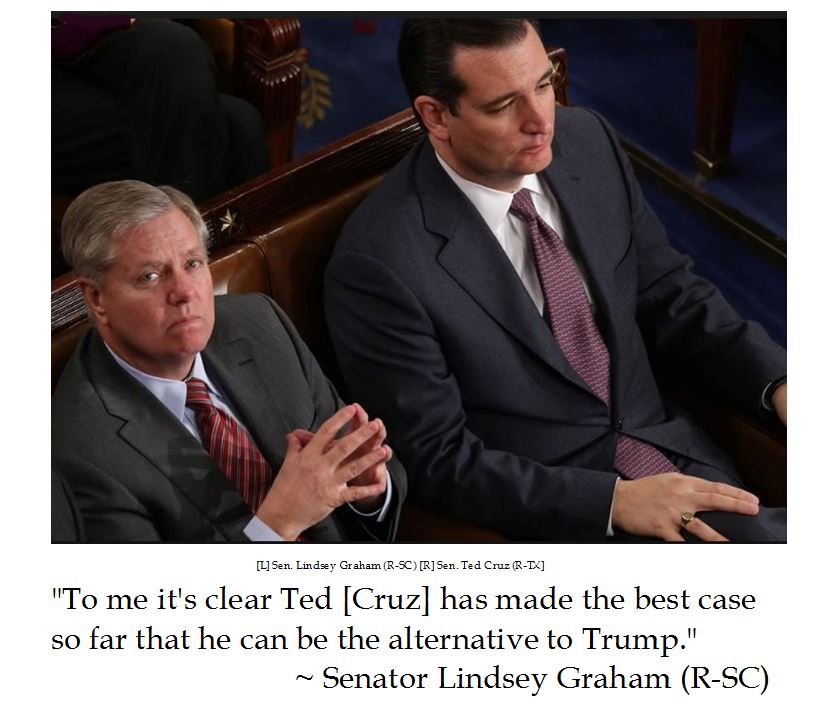
Senator Lindsey Graham (R-SC) is an Establishment Republican who dropped out of the 2016 Republican Presidential nomination race for lack of support. Still, Graham strives to play kingmaker for the nomination.
First, Lindsey Graham endorsed ex Governor Jeb Bush (R-FL) to little avail in New Hampshire or even Graham's home state of South Carolina. Jeb! dropped out after his disappointing fourth place finish in the Palmetto State.
Afterwards, Graham tried to ply his comedic charm to sway voters in the GOP primary process, by grossly joking that his fellow Senator Ted Cruz (R-TX) is so unpopular on Capitol Hill that someone could kill him on the Senate floor and there would be no convictions.
But now that Donald Trump is threatening to be victorious in the Republican nomination race, Establishment Republicans are looking for an alternative to Trump. Thus the GOP-e has desultory jumped from Jeb to Marco and Kasich to little avail.
Now Senator Graham has been charily campaigning on behalf of Senator Cruz as an alternative to Trump. In Graham's estimation, Cruz ought to pair up with Senator Marco Rubio (R-FL) as a unity ticket.
Of course, after Rubio cratering in the March 8th primaries, in which he came in last place in all four contests and netted scant candidates, this may no longer be viable.
It is ironic that DC Establishment types are now touting anti-Establishment candidate Cruz, the between the beltways Cocktail Party has a Damaclesian choice, and in his mind Graham is opting for the devil he knows rather than the devil he does not know.
Monday, March 7, 2016

Thursday, March 3, 2016
Kasich Stoops to Conquer

At the close of the Detroit Fox New GOP Debate, Governor John Kasich likened himself to "the Little Engine that Could". How presidential/sarc.
Perhaps this puerile position may have some appeal to voters. Before the New Hampshire primary, Kasich sold himself to skeptical voters to being the mush that was just right ala Goldilocks and the Three Bears.
Monday, February 29, 2016

Wednesday, February 24, 2016

Monday, February 22, 2016
Lindsey Graham Crackers on a Potent GOP Ticket

Senator Lindsey Graham (R-SC), a 2016 Republican Presidential who dropped out before the first ballot was cast, is again trying to play king-maker. Graham's ignominious exit from the race in December paved the way for establishment Republicans, to back former Governor Jeb Bush in New Hampshire and South Carolina. Graham's endorsement of Jeb did not hold sway in the Palmetto State Primary and Jeb honorably dropped out of the race.
Nonetheless, Graham fancies that there might be a potent Republican ticket by cobbling together Governor John Kasich (R-OH) and Senator Marco Rubio (R-FL). Kasich did come in second in the New Hampshire primary, primarily by practically moving to the Granite State and holding 100 town hall meetings. Rubio came in third in Iowa, fourth in New Hampshire, and was basically tied for second in South Carolina with Senator Ted Cruz (R-TX).
Graham's modest proposal epitomizes the Republican establishments animus against Donald Trump and their thinking on how to win over an angry electorate, by heralding two candidates who project a nice guy image and whose records incorporate some centrist tendencies (like Rubio on Gang of Eight immigration compromises and Kasich on Obamacare accommodations).
It would be interesting to see if Graham's proposed dream team are able to win their home state's of Florida and Ohio for the winner take all primaries on March 15th. As it stands today, it is dreaming an impossible dream for both proposed potentates. Graham's prognostication serves as a reminder that he was raised above a liquor store.
Friday, February 19, 2016
Tool Time: Kasich A Republican Democrats Would Like

Tim Allen, the star of Home Improvements and Last Man Standing, is one of the relatively few outspoken Republicans in Hollywood. Allen recently skewered the Clinton's as something from which American just can't get away.
When interviewed on Fox New's The Kelly File, Allen offered some serious remarks regarding the Republican Presidential primary campaign. The analogy that Governor John Kasich (R-OH) is a Republican that Democrats would [almost] like will be tested tomorrow in the South Carolina Primary.
It is dubious that there will be many crossover votes for Kasich, considering the populist appeal for Trump-eteers and the close nature of the Democrat's South Carolina Primary on February 27th.
Despite Kasich picking up endorsements from two prominent South Carolina's newspapers, I suspect that Allen's offhanded endorsement may be the kiss of death for the Ohio Governor in the Palmetto State. Nevertheless, I would not suspect that Kasich would drop out before March 15th, when the winner take all Ohio primary occurs. Maybe a favorite son candidate like Kasich could win 99 delegates. This would help him if there is actually a constested convention for the Republicans in Cleveland.
Tuesday, February 16, 2016
Parsing Political Polling

In the 2016 Election Cycle, the Republican Presidential Primary has been driven by plethora of political polls. In fact, Donald Trump regularly trumpets his lead in “all the polls”. Yet Trump was surprised when he underperformed in the Iowa Caucuses, which has prompted bizarre tangents that the Manhattan Mogul really should have won the contest.
To try to educate enthusiastic but unsophisticated political partisans, here are some things to look for when considering the merits of polls.
Internet polls are unreliable. If this were not the case, former Representative RON Paul (R-TX 14th & 22nd) would have been the GOP nominee in 2008 and 2012 based on Internet Polling. There is no sampling, nor fail-safe ways to prevent over-voting. Internet polls do give an indication of social media enthusiasm, but this can be gamed and is not indicative of real grassroots support.
For the primaries, national polls are misleading as they mainly give a gauge of name recognition. If a candidate is well known, such as Hillary Clinton (D-NY) for the Democrats or Donald Trump competing in the Republican primaries, national polls can seem skewed towards them.
Given this reality, such candidates may craft their message to be one of inevitability. This pitch can be a perception that the nomination process is a coronation or that the leader in the national polls will sweep the table.
There are some sources, such as Real Clear Politics, which will combine polls to give a national average. This can give some indication about movements by candidates, but since this merges different methodologies, it is dangerous to rely upon the specific numbers.
In our system, however, states hold primaries. These states have different primary electorates, and often vote on different dates so candidates’ messages are often tailored to appeal (perhaps pandering) to particular audiences. For example, Ohio Governor John Kasich started to drop his “n”s in and be downhome in evangelical appeal at the last South Carolina primary. Sometimes this strategy works, but it can come off as unctuous and inauthentic.
While state polls can be more illuminating, there are still lots of details one must discern in the cross tabs. Most casual consumers of campaign news only listen for the top line results, either the pecking order or the purported percentage of support. The crosstabs involve the margin of error.

For example, this CBS GOP bar graph for the South Carolina polling has a Margin of Error (MOE) of 5.7%. A useful rule of thumb is that ANY poll with a Margin of Error of more than 5% is practically meaningless. In this instance, Senator Ted Cruz could have 25.7% support or as little as 14.3%. Senator Marco Rubio (R-FL) could vault into second with up to 20.7% or drop into a tie for fourth place at 9.3%. That large range makes most of the pecking order suspect.
Then there is the question of who makes up the body of those who are polled. Asking any American is dubious for primaries as most of those contests are closed. So if a poll’s sample is skewed 80% Democrats for a Republican primary, the results will be apple-sauce. A slightly more reliable class is registered voters, but without separating party affiliation, this will still be suspect. The gold standard is likely voters for a given party.
In order to find a pool of likely voters, pollsters will ask vetting questions to ensure that the surveyed voter has cast ballots in several past elections. This takes time and costs the pollster money, but is much more reliable than something like an internet poll with trolls clicking out of their parents’ basement.
Polling is both an art and a science. The pollster needs to predict what is the right turnout model for an election. Grassroots Republicans are more likely to turn out in off-year elections. There were extraordinary turnouts of new voters and African American voters who turned out for President Barack Obama in 2008 and 2012. Will the same numbers of voters return in elections where Mr. Obama is not standing? It can be a major mistake for pollsters to use the wrong model when predicting elections
Determining the right sample is imperative and may explain the disparity between the polls and the Iowa Caucus results. Prior to the Hawkeye Cauci, it was postulated that Trump needed to turn out a large swell of new participants to the caucus. The Trump campaign did not concentrate on Get Out the Vote efforts. Nevertheless, there was a large contingent of “new voters”, but the new voters were disinclined to support Trump.
Public polls are only news if a news source determines that it is fit to print and advances their narrative. Some news sources have sat on poll results which do not augment their desired narrative, or they will bury them with Friday afternoon releases or on the back pages.

It used to be Gallup that was the standard, but they seemingly have bowed out of election polls. But not every polling company is the same For instance, Public Policy Polling tends to be a Democrat operation. So their results may be crafted to make mischief for Republicans or have flawed methodology.
The manner which a prospective pollee is contacted may influence the results. It used to be that telephone polling was pretty reliable. However, now that many households have dropped land-lines, results including cell-phone callers can be questionable. When you call also matters. If pollsters will reach fewer Republicans at home during weekends, which may adversely affect the numbers. There is some thought that people are more likely to tell pollsters that they support Trump if it is an automated call rather than person to person.

Robo-call polls are not really meant to measure support for an election field but are the cover for push polling. In puah polls, if a voter indicates that they like candidate X, they may be told adverse information meant to dampen support for that candidate. Trump has been complaining about Cruz’s robo calls about Trump dropping out, but it seems like Trump is fulfilling that premise with insinuations that he might quit if the GOP does not treat him right.
Exit polls, which are conducted on election day, after a voter has casted his ballot, often are instructive in the eleventh hour. These exit polls can be off the mark if there is too small of a sample, if the chosen precincts are not representative of the electorate and the reality of some voters will not tell the whole truth to their interviewers. Exit polls give news organizations a heads up on probable election results before the polls close and facilitate in forecasting end of the evening winners. Aside from inquiring about the actual candidate, exit polls can be a barometer about what were the real hot button issues for voters and give the media something to talk about as the election returns start to come in.

It is unfortunate that in the 24/7 news cycle, many media sources will use horse race polls of dubious merit to fill their time and create excitement in the electorate. This can create false expectations by those who just scan the headlines.
There are internal polls which are commissioned by campaigns. These internal polls can give politicians a real reading of the electorate. These internal polls can also be enlisted to hone a message to find out what are hot button issues or what is a better way to couch a policy proposal. But these internal polls can also convey wishful thinking. When a campaign leaks an internal poll, they may be giving credible alternative information ignored by the drive-by media. Or it could be releasing agiprop to staunch waning support or to create a perception of a surge.
Instead of premising political support on the bandwagon effect, voters should make up their own minds and not be framed by the primary polls. The reality is that the only poll that counts is on Election Day. If the eventual winner of the primaries is not one’s cup of tea, other metrics may be called for in the General Election.
Monday, February 8, 2016
Porridge and Politics in the Granite State

During a towhall meeting in Windham, New Hampshire in the hours before the New Hampshire primary, Governor John Kasich (R-OH) fielded a question from an undecided voter who might vote in either the Democrat or Republican primary.
\\
Kasich tried to sway the woman by using a Goldilocks and the Three Bears analogy, claiming that he was the "porridge that was just right. Conservative cynics might liken Kasich's policy positions to be mush.
No wonder Kasich thought that he would do well in the Democrat primary. The moderate Ohio Governor had better hope that the undecided voter casts a ballot in the proper primary.
Sunday, February 7, 2016
Dealing with Glitches in the GOP Debate

Republican Presidential hopeful Senator Marco Rubio (R-FL)'s rapid rise in the primary political polls has been premised on strong debate performances. Rubio is articulate, some say smooth talking, in giving upbeat bite sized morsels during his time on the debate stage.
Rubio surprised many political observers by his showing at the Iowa Caucuses, where he came in third as expected, but only 1.5% behind second place finisher Donald Trump.Thus his rapid rise made him a prime target at the Republican Debate held three days before the New Hampshire Primary. So he should have known what to expect.
After seven prior Republican debates, astute observers know candidates' patterns of behavior. Ex Governor Mike Huckabee always slung "canned ham", hokey pre-written one line zingers designed to make him seem like the funny every-man's candidate. The Iowa Caucus echo of Adele "It's Me" was expected but still amusing. Donald Trump (when he deign to show up for a debate) will start being subdued but eventually with squabble with Jeb! Bush. Dr. Ben Carson will joke about how little time he is being allotted and will do a data dump on questions not posed to him.Governor John Kasich (R-OH) will wildly flail his hands when speaking at the podium with occasional karate chops for rhetorical punctuation.
Senator Rubio was wont to retell his family's remarkable American Dream story, which loses its effectiveness after it has been used a few times. Rubio also had the habit of asking people for their vote in a close, which gets a bit cloying. Wisely, Senator Rubio has dropped both tacts. As for style, Senator Rubio shoots for the American Dream in some responses and then tries to focus attacks on Obama and Hillary, while subtly shivving other candidates in the back. This approach has given Rubio great favorability ratings. Along with his strategy of heavy paid media campaign advertising, it has precipitated his top tier status.
Governor Christie is staking the fate of his entire campaign upon doing well (placing in the top troika) in the New Hampshire Primary. For the week before the Republican Debate in Manchester, Christie had been gunning to take Rubio down a couple of notches, deriding him as "Bubble Boy", who was not accessible to voters or responding to tough questions. Other have ripped Rubio as being robotic. So the critiques were being telegraphed to Rubio. Yet the freshman Florida Senator displayed a glaring glitch.
It seems that Rubio got rattled after Christie repeatedly rubuked him for giving memorized 30 second speeches. Almost to prove his point, Rubio blurted out similar tracks about President Obama four times in four minutes. In post debate spin mode, Rubio claims that he is passionate about this position and wishes people would keep playing the clip. The episode inspired a parody Twitter account "Marco Rubio Glitch".

Unfortunately, that was not the only instance were over-preparation showed. In his answer about the military, Rubio began his answer, then stopped and began again because his memorized stump speech had to be delivered in that order. Again, this glitch contributes to the charge of being robotic and mars an otherwise good debate performance, with excellent responses about ISIS and defining conservativism.
I do not begrudge candidates doing preparation work prior to a debate. In fact, it shows some respect for an audience and hones a message, unlike Donald Trump's flippant definition of conservatism as "conserving money". However, it is most effective if the audience is unaware that you are prepared. For example, Huckabee's canned ham are groaners because you know there are not spontaneous and he stained to find the opening to launch the zinger.
Similarly, by regurgitating the same rhetoric several times in a short span sounds robotic and pre-programmed. Discerning viewers are prompted to question authenticity. It begs the question of how a candidate will stand stricter scrutiny in the General Election campaign.
Sometimes glitches underline growing perceptions. Ben Carson had developed a whiney reputation from the debates for not getting enough recognition or time allotments. The Carson campaign seized on a kerfluffle over a CNN news report at the start of the Iowa Caucuses that Carson was taking time from the campaign trail prior to the New Hampshire Pimary. Both the Cruz and Rubio campaigns spun this news to their grass-root leaders in the Caucuses to garner more votes. Carson took umbrage exclusively at Senator Ted Cruz (R-TX). Cruz quickly apologized for not passing along subsequent reports. Carson claimed as a Christian he accepted the apology but then priggishly seemed to require conditional forgiveness. Cruz apologized again at the Manchester Debate, but that did not seem to assuage Dr. Carson's animus.
But as the candidates were being introduced onstage at the Manchester Debate, there was a technical glitch to cue Dr. Carson so he remained waiting in the wings, even as a stage manager gestured for him to take his place. The ABC News Moderator David Muir had to invite Ben Carson for him to go to his podium. Afterwards, Carson complained about not being introduced second.
This strange stagecraft, combined with a perception of priggish prissiness in politics, made it seem like Carson was being stand-offish because of a pecking order failure. Along with Carson's standard complaint about being ignored and his refusal to accept Cruz's repeated apology, it gave a bad impression. The technical glitch may have be inadvertent, but the cascade of a candidate who stands on heirs and hardly seems like he is working to win was a tough impression to shake.
 Most of the time, people do not remember the substance of a debate but their impressions. Famously, in the 1960 Presidential Debate, the radio audience thought that then Vice President Richard Nixon (R-CA) bested then Senator John Kennedy (D-MA). But the vast majority of the audience was on television, and they remember Nixon's five o'clock shadow vis-a-vis a tan, rested and telegenic Kennedy.
In the 1980 Republican New Hampshire scheduled with then George H.W. Bush one on one debate, all people remember is then former Governor Ronald Reagan (R-CA) saying: "Mr. Dean [editor's note- which was actually the wrong name], I paid for that microphone." It showed assertiveness and authority.

Or the 1992 Richmond Town Hall debate when President George H.W. Bush was caught on camera looking at his watch. It gave the perception that Bush looked bored.
Then there was Vice President Al Gore's audible sighs in the 2000 Debate, which in retrospect he may have wanted to keep in a lock box.
How much the Rubio Glitch or the Carson miscue sticks in the minds of Granite State primary voters remains to be seen. At the very least, Rubio's less than stellar Manchester debate performance has halted his meteoric rise in the media and may prompt another antagonizing reappraisal by the GOP establishment of which horse to back against insurgent outsider candidates.
Saturday, February 6, 2016

Wednesday, January 20, 2016
John Kasich's Modern Manichaean Metaphor

John Kasich's self assessment on the Hugh Hewitt show sounds like modern Manichaeism. But Kasich has often self righteously pushed a Christian social gospel as he has been on the Presidential hustings.
Wonder where Kasich stands on Two Corinthians (sic). In addition, wonder how the heavens consider his monicker of Prince of Light and Hope.
Wednesday, October 28, 2015
Governor John Kasich Unleashed?
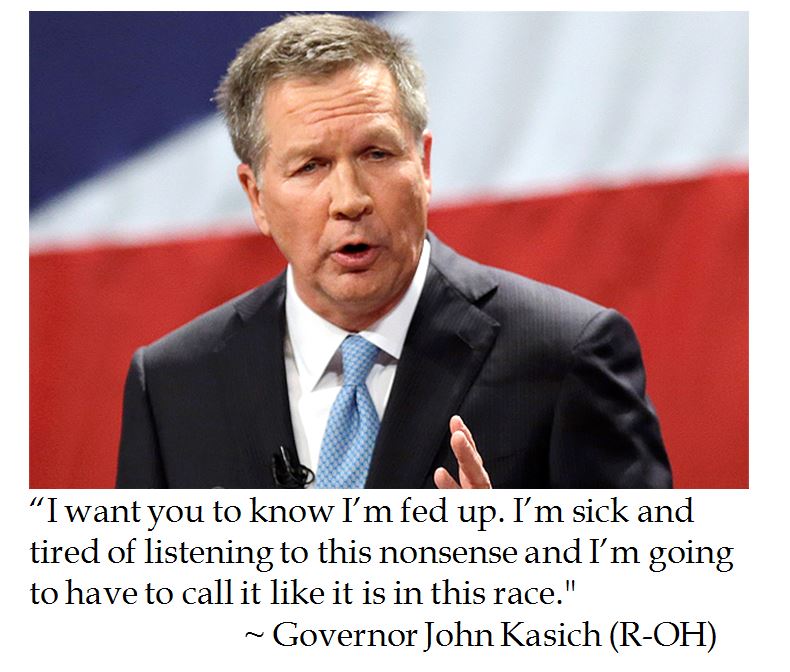
What happened to the bleeding heart conservative Governor who invoked the Gospel to justify his Medicare policies? It seems that in order to get traction in the 2016 Primary, Kasich has calculated that he has to appear unleashed.
Such brusque blurtations seems to have been successful so far for Donald Trump. Will this work for a prickly establishment candidate waiting in the wings for a Jeb crash and burn?
Subscribe to:
Posts (Atom)