Showing posts with label NPR. Show all posts

Saturday, January 13, 2018

Is Barack Obama Really Trying to Bridge News Universes?

Ex President Barack Obama bemoans lack of commonality on the news during Letterman Netflix interview

During the initial episode of David Letterman's new limited run program on Netflix "My Guest Needs No Introduction", former President Barack Obama laments the lack of a common baseline of facts for the news.


 In some ways, this echoes a theme that Mr. Obama emphasized in his BBC Radio interview with Prince Harry about finding common realities on the internet. And during the speech at the Dallas Police Shooting Memorial, then President Obama lamented political polarization stemming from news coverage.  

Yet is is hard not to appreciate Obama's implication that those watching Fox News are "way out there" vis-a-vis the Mainstream Media represented by  taxpayer supported National Public Radio. His quip served as a laugh line to the Netflix audience at City College, New York. Such a jibe will affirm the biases of coastal elites who cannot fathom how fly over country could vote for a guy like President Donald Trump.  But it inspires a broader question of what is news and what is the prudent way to discern truth on current events. 

Some have fantasized about having a group that evaluates the news for its truthfulness.  But as it has been tried by Politifact's Truth-o-Meter  and the Washington Post's Fact Check with the Pinocchio scale, it has proven to be skewed and lacking. 


It is repugnant to the First Amendment to contemplate having the government take a role in vetting media.  It is bad enough that social media giants like Facebook and Twitter are using "curating" newfeeds to avoid conservative stories deemed as "fake news" and algorithms which shadowbans opinions not in favor with the social media powers that be. 

Then there is the question of how to cover a story.  Recently, CNN launched an advertising campaign with the spot "This is an apple" touting "Facts First".   The Media Research Center's study of coverage of the first eight months of the Trump Administration was 91% negative stories. In another study, the MRC examined one day of coverage on CNN, when 92% of the airtime was focused on President Trump, and CNN used 96 critics and seven supporters to back up their coverage. That hardly seems like facts first or fair and balanced news.

A more difficult thing to detect is the news that the mainstream media chooses not to report. A concrete example is when undercover video exposed that Planned Parenthood clinics were selling baby body parts.  Network news did not give one second of coverage, probably because it sullied a cause with which the networks suits agree. No wonder why there is a populist outcry against "Fake News".

Another niggling aspect is what "news" mainstream media outlets choose to report.  It is interesting to see how much that makes it on a network nightly news is just recycled packages that were creating for fluffy morning news shows. ABC is notorious for cross promoting entertainment programming as news.  The Tonya Harding 20/20 episode seemed to give as much airtime to its affiliated journalists as the protagonists in order to hype a film poised for Best Picture for the Oscars, which will be broadcast on ABC.  One should expect that NBC's News will be chock full of Olympic feature stories (as it broadcasts the Winter Olympics in February) when it is not bashing the Trump Administration.

As a news junkie, it is laudable to seek out news sources which do not comfortably give "confirmation bias".  In addition, it is necessary to vet the reliability of news sources when considering stories.  However, it is dubious that President Obama wants to find a real "baseline of common facts".  His out of this world comment seems more inclined to smear those who do not buy into the line from the mainstream media, shaped by the likes of the Journo-list and then disseminated via papers of record, like the New York Times and the Washington Post, which then dictates the coverage in most of the rest of the media.

As much as one would like to believe that Mr. Obama is trying to bridge news consumption universes, this comes from a leader who gathered lawmakers around a table supposedly to work together on health care and then wanted to dictate terms.  It is likely that politically correct pressure about the consensus on the news would drown out minority opinions and counter facts.  So it would be like the pre-internet "fairness doctrine" days when there was little choice and the public could be simply swayed. 

Tuesday, April 25, 2017

Paying Tribute to Quality-- RIP Robert M. Pirsig


Author Robert M. Pirsig died at the age of 88 in South Berwick, Maine after a period of failing health.  Pirsig was renowned for writing Zen and the Art of Motorcycle Maintenance-- An Inquiry Into Values (1974), a loosely autobiographical travelogue of a 17 day cross country road trip in 1968 with his 11 year old son and two friends during which he pondered weighty philosophical problems to discern the metaphysics of quality,  

Pirsig had served in the Army in the Far East before the Korean War.  During a trip on leave to Japan, Pirsig became fascinated by Zen Buddhism. After his military service, Pirsig received graduate degrees in Philosophy from the University of Chicago and Banaras Hindu University.

Like the unnamed protagonist in the novel, who sometimes referred to himself as Phaedrus (a name inspired by Plato's Dialogues),  Pirsig was a brilliant thinker with a high IQ who eventually suffered a mental breakdown which was treated by electro-shock therapy that altered his personality. By delving deeply into undercurrents of thought, the novel can be seen as a detective story of a man in search of himself.


Robert M. Pirsig, 1975
The title of the book was a play on another popular tome Zen and the Art of Archery (1971). Pirsig's playfulness was also evident in the forward in which the author wrote:


"Zen and the Art of Motorcycle Maintenance should in no way be associated with that great body of factual information relating to orthodox Zen Buddhist practice. It’s not very factual on motorcycles either.”
But the book contemplated how man relates to machines, the roots of our culture and what inspires madness.


Plato & Aristotle "The School of Athens" Raphael (1510)
Phaedrus ordered existence between "classic" values (like rational problem solving in fixing motorcycles) and "romantic values" (like beauty and the arts). This philosophical chautauqua ("circus of ideas) which Phaedrus grappled with in his deep thoughts was how the Western mind had separated ordinary experiences from transcendent experiences because Plato and Aristotle had done so. Moreover, the mind-body dualism championed by the Greeks stoked a mental civil war which stripped rationality from its spiritual underpinnings and spirituality of its reason.

What man really ought to strive for is quality.  As Pirsig contemplated:


"Quality . . . you know what it is, yet you don't know what it is. But that's self-contradictory. But some things are better than others, that is, they have more quality. But when you try to say what the quality is, apart from the things that have it, it all goes poof! There's nothing to talk about. But if you can't say what Quality is, how do you know what it is, or how do you know that it even exists? If no one knows what it is, then for all practical purposes it doesn't exist at all. But for all practical purposes it really does exist."


The book became a phenomenon which the author later described as a “kulturbarer" (Swedish for culture bearer), which developed a near cult popularity amongst hippies.  Pirsig mused: “I expressed what I thought were my prime thoughts and they turned out to be the prime thoughts of everybody else." Zen and the Art of Motorcycle Maintenance truly appealed to Baby Boomers. When the novel was first published, New York Times reviewer Christopher Lehmann-Haupt wrote: 


"[H]owever impressive are the seductive powers with which Mr. Pirsig engages us in his motorcycle trip, they are nothing compared to the skill with which he interests us in his philosophic trip... when [Pirsig] comes to grips with the hard philosophical conundrums raised by the 1960's, he can be electrifying." 
 When reflecting on the impact of ZAMM, Todd Gitlin, a counter cultural sociologist speculated that by blending the deep thoughts with the drudgery of daily life, such as motorcycle maintenance:  "Pirsig provided a kind of soft landing from the euphoric stratosphere of the late ’60s into the real world of adult life.”

The counter cultural novel sold over one million books in the first year of its publication and sold several million more since then.  Zen and the Art of Motorcycle Maintenance became  the biggest selling philosophy book of all times and remained on the best sellers list for over a decade. This is remarkable for a manuscript which was rejected by 121 different publishers before William Morrow signed hi for a small $3,000 advance.

After the unexpected success of Zen and the Art of Motorcycle Maintenance, Pirsig won a Guggenheim fellowship, some fortune and unwanted fame. Pirsig got so freaked out by what his neighbors called "Pirsig Pilgrims" to his Minneapolis home that he eventually packed his bags and would live in a camper or a sailboat for months.  Pirsig spent the last 30 years of his life in a small town in Southern Maine

Pirsig wrote one other book, Lila- An Inquiry into Morals (1991), which achieved neither the same success nor cultural impact.  But sometimes one oeuvre is enough to make one's mark on the world. 

Personally, I found Zen and the Art of Motorcycle Maintenance to be a highly influential book. Believe it or not, it served as a textbook for an Advanced Placement American History course in high school. Despite the unorthodox textbook, I achieved highest marks on the exam as it honed in me an incredible analytical inclination which remains with me to this day (sometimes to the consternation of those close to me).  

While I may not be an adherent to Zen Buddhism, nor will anyone catch me fixing motor scooters or the ilk, I am graced by the idea that there is a nexus between the simply joys and drudgery of daily life and the transcendent. More than a quarter century later, I am still inspired by a quest for quality. To be so deeply impacted by a book demonstrates its importance. 


Robert M. Pirsig on Life


H/T: New York Times
        NPR


Monday, September 12, 2016

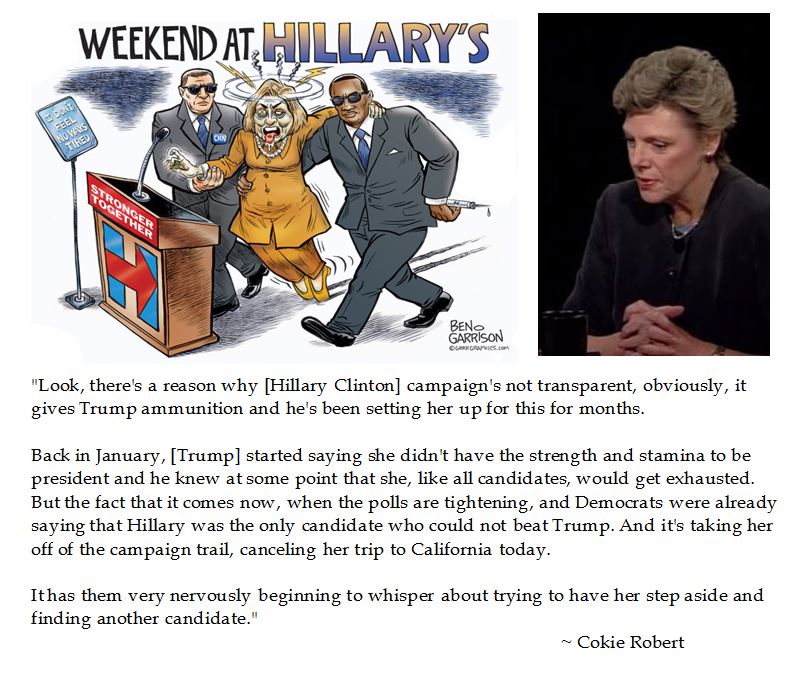
More Hints of Democrat Skiddishness About Hillary's Health

NPR Commentator Cokie Roberts considers if Hillary's Health Might Necessitate Dropping Out of Election 2016

After Democratic Presidential nominee Hillary Clinton (D-NY) had her medical episode at the 9/11 memorial, MSNBC's David Shuster posted on Twitter scuttlebutt that the DNC would be considering options if their nominee had to be replaced.  

This report was not a one-off.  NPR's political commentator Cokie Roberts also considered the skiddishness that some Democrats have at the Hillary's Health issue.


Roberts emphasized that the manner in which a national nominee could be replaced was by an emergency vote called by the chairman of the Democrat National Committee and won by a majority vote of those present.  

Perhaps the resignation of Rep. Debbie Wasserman Schultz as DNC Chair and her temporary replacement by Donna Brazile will make a difference if push comes to shove.

Thursday, April 12, 2012

Keeping Politically Curious on Public Broadcasting


The Ninth Circuit Court of Appeals has struck down the ban on political advertising for public radio and television stations on a 2-1 vote. But Judge Carlos Bea affirmed the ban on for profit companies advertizing goods and services...

Be mindful that this is the Ninth Circuit, has a reputation of being the most overturned federal jurisdiction. But for this election cycle, prisoners of PBS might be praying for telethons rather than the onslaught of election ads.

READ MORE at the DCBarroco website.