Showing posts with label World War II. Show all posts

Tuesday, April 18, 2017

Commemorating the 75th Anniversary of the Doolittle Tokyo Raids

Lt. Gen. Jimmy Doolittle on War and Air Power


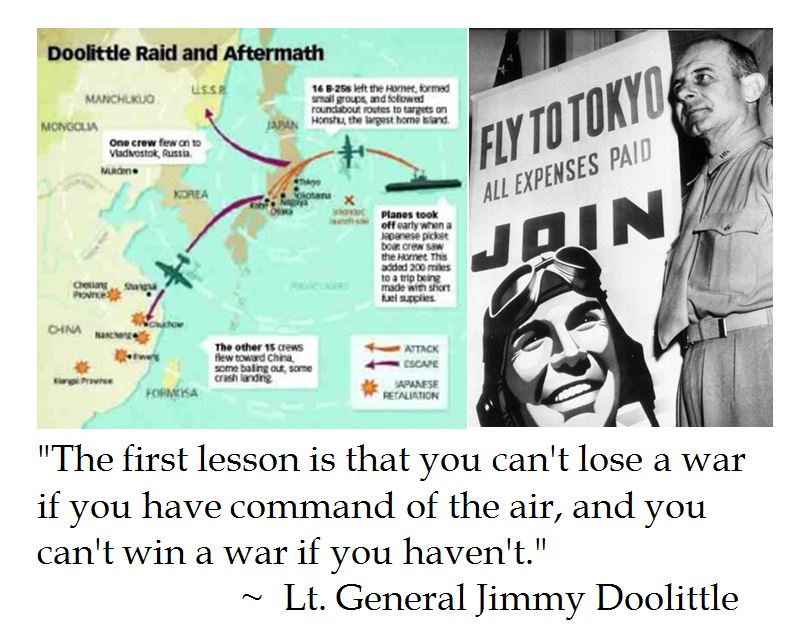
Just a little over five months after the devastating Japanese surprise attack on Pearl Harbor, the United States  made a daring raid on the Imperial Homeland.  The responsibility to conduct the raid fell upon then Lt. Col. Jimmy Doolittle, a revered test pilot for the U.S. Army Air Corps.   

Sixteen specially modified B-25B bombers carrying 80 men took off at night from the USS Hornet on April 18, 1942, which was positioned 500 nautical miles off the Japanese mainland.  The plan had to be rushed as the Hornet was sighted further out than expected.

The Army Airmen participating in Doolittle's raid understood that they were most likely on a suicide mission. Their intended targets were military and industrial targets in Tokyo, Yokohama, Kobe, Osaka, Nagoya and Yokosuka. One of the sixteen planes had to bail before it reached its target.  

Remarkably despite losing 15 aircraft, only four of eighty men were killed  in the Doolittle Raid, eight became POWS (but three were executed), and one crew was interned after landing in Vladavostok, Soviet Russia.  They were held in the USSR for a year and were "smuggled out" (probably arranged by the Russian Secret Police NKVD because the USSR could not release the prisoners because of the neutrality pact with Japan).


Doolittle expected to be court marshaled as his raid lost 15 of 16 aircraft in pin prick air strikes.  But back in the United States, the daring Doolittle Raids was celebrated as a morale building first strike against Imperial Japan.  The Japanese were caught off guard by the Tokyo Raid and the Imperial Military rearranged forces, which might have turned the tide in the Battle of Midway in June 1942.


Doolittle received the Medal of Honor from President Franklin Roosevelt, with the citation:


"For conspicuous leadership above and beyond the call of duty, involving personal valor and intrepidity at an extreme hazard to life. With the apparent certainty of being forced to land in enemy territory or to perish at sea, Lt. Col. Doolittle personally led a squadron of Army bombers, manned by volunteer crews, in a highly destructive raid on the Japanese mainland."

Doolittle was eventually promoted as a Lt. General and became the highest ranking active reserve officer in modern times. 

Sometimes the bigger battle is won through morale boosting and reminding America of its mission.

Monday, January 30, 2017

Honoring Jan Karski, the Messenger from Hell

Polish WWII Resistance Fighter Jan Karski on Democratic Societies


Today in a ceremony in Manhattan, academics posthumously honored longtime Georgetown University professor Jan Karski, a man who tried to prevent the Holocaust by sharing the truth. Alas, politicians among the Allies were tardy to act of the news from Karski as the Messenger from Hell.


During the Second World War,I Karski was a Second Lieutenant in the Krakow Valvary Brigade who was captured after the battle of Tomaszow  (1939) by the Russians. But due to Karski's birthplace, the Russians handed him over to the Germans, thus he avoided being a victim of the Katyn massacre of 1940. 

Karski escaped his German POW train in 1939 and escaped to Warsaw where he joined the Polish Resistance movement. Larslo  organized courier missions to the Polish Government in exile headquartered in Paris andhe himself made several secret trips to France and Britain. Karski was eventually captured by the Gestapo and tortured in Slovakia but was later smuggled out and rejoined the Polish Resistance. 

In 1942, Karski was selected by Polish Prime Minister in exile  Władysław Sikorski to go on a secret mission to gather first hand information about the Nazi atrocities in occupied Poland.  Karski was smuggled into the Warsaw Ghetto. Karski also sought to infiltrate the Belzec death camp as an Estonian guard.  Although Karski only managed to see a transit station, the horror that he witnessed first hand was appalling.  

After briefing the Polish Government in exile upon his return to London in 1942, Karski met with other exiled Polish politicians and British Foreign Minister Anthony Eden about his first hand testimony about the Holocaust.  In June of 1943, Karski traveled to the United States to personally brief President Franklin Roosevelt, as well as other American civic and government leaders, including Secretary of State Cordell Hull and Associate Supreme Court Justice Felix Frankfurter, without much effect. Karski published his recollections Courier from Poland: The Story of a Secret State (1944) which sold more than 400,000 copies. 

Eventually Jan Karski settled at Georgetown University, eventually earning a Ph.D in 1952 and taught there for over forty years. Georgetown remembers Jan Karski as many things — a beloved professor, writer, and colleague, to name a few — but to the world, he was known as one of the first to warn Western powers of the horrors of the Holocaust.

Jan Karski at Yad Vashem (circa 1982)
Although Karski was a Roman Catholic, he felt a profound connection with the people whose lives he attempted to save from the Holocaust.  In 1981, Karski said: “All murdered Jews became my family. I am a Christian Jew.” In 1982 Karski was recognized by Yad Vashem as Righteous Among the Nations.  

In 1991, he received the Wallenberg Medal from the University of Michigan for his outstanding humanitarian efforts.  In 2012, President Barack Obama posthumously awarded Jan Karski the Presidential Medal of Freedom for his heroic witness to the ugly truth of the Holocaust.  Mr. Obama proclaimed: "Jan Karski -- a young Polish Catholic -- who witnessed Jews being put on cattle cars, who saw the killings, and who told the truth, all the way to President Roosevelt himself."   

"Whoever does not condemn, consents" mural in Warsaw

Karski's faithful witness has been remembered from murals in Warsaw to a series of five bronzes of Karski sitting on a bench playing chess created by Krakow sculptor Karol Badyna which are located in Georgetown, Manhattan, Lodz, Warsaw, Keilce and Tel Aviv University in Israel. 

Thursday, July 16, 2015

Robert Oppenheimer on Trinity

Robert Oppenheimer on Trinity

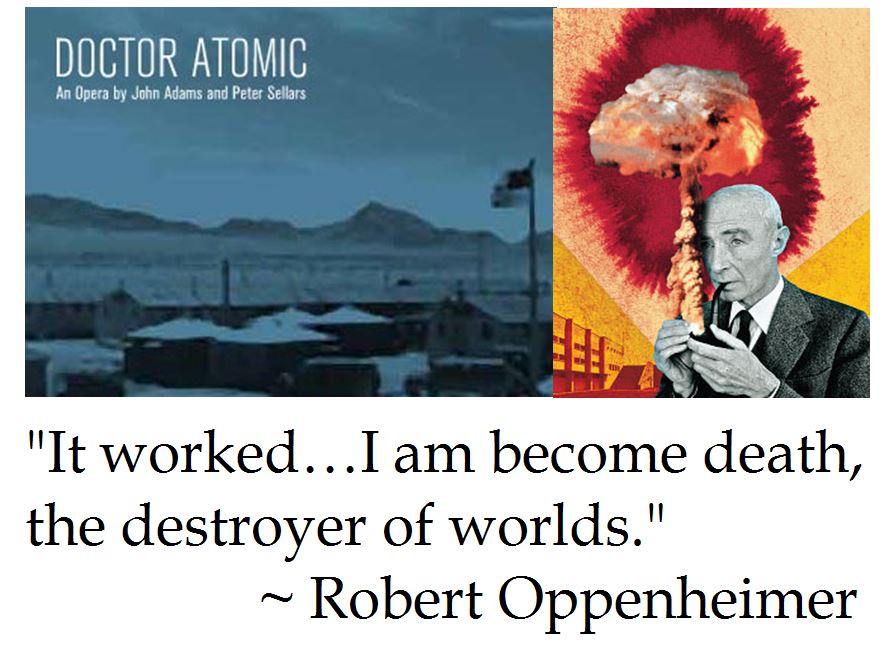
Robert Oppenheimer, the American theoretical physicist from the University of California at Berkeley, headed the Manhattan Project since 1942 thus he was dubbed "the Father of the Nuclear Bomb" or Doctor Atomic. 

 The Manhattan project moved from New York City to Los Alamos, New Mexico in order to maintain great secrecy for the American World War II effort. Eventually, the remote, desert like compound grew to more than 6,000 people.  

No one was sure what would happen when testing "the bomb".  Some worried that the detonation would light off the atmosphere.  But on July 16th, 1945, the Manhattan Project achieved a success with the detonation of the first nuclear bomb near Alamagordo, New Mexico (code named "Trinity")

 When reflecting upon the successful explosion of the Trinity bomb, Oppenheimer mused that he thought of a Hindu verse from the Bhagavad Gita: "Now I become death, the destroyer of worlds." Oppenheimer may have internally mused that verse, but Oppenheimer's brother was an eyewitness to Doctor Atomic's reaction, and all he said was "It worked." Brigadier General Thomas Farrell was also an eyewitness to Oppenheimer's reaction in the Trinity control bunker, and Farrell observed:
Dr. Oppenheimer, on whom had rested a very heavy burden, grew tenser as the last seconds ticked off. He scarcely breathed. He held on to a post to steady himself. For the last few seconds, he stared directly ahead and then when the announcer shouted "Now!" and there came this tremendous burst of light followed shortly thereafter by the deep growling roar of the explosion, his face relaxed into an expression of tremendous relief.
This was the only bomb that the Manhattan Project possessed.  However, within three weeks, two atomic bombs were ready for use in the Pacific theater to try to obtain unconditional surrender from the Japanese. 

In 2005, composer John Adams premiered an opera "Doctor Atomic"  with the San Francisco Opera in which  much of the libretto was based on declassified American government documents about the Manhattan Project.