Some consider the Nation’s Capital as “Fantasyland on the Potomac”. Other outsiders are “Fed Up” with the Federal City. It's better to consider D.C. as “the District of Calamity” (sic).
NBC News is reporting about a July 20th meeting between President Trump and Pentagon officials in which he expressed an interest in greatly increasing America's nuclear stockpile. This exhortation was prompted by a slide which showed that America's nuclear arsenal was at its peak in the late 1960s, which Mr. Trump approved. Rather than interpret this approval as a desire for a ten fold increase from today's nuclear levels, military officials appreciated it as the Commander-in-Chief wanting to increase America's military strength. This is consistent with Mr. Trump's pre-inaugural predilection to increase and expand America's nuclear capabilities. But the episode revived questions about President Trump's familiarity with America's nuclear triad.
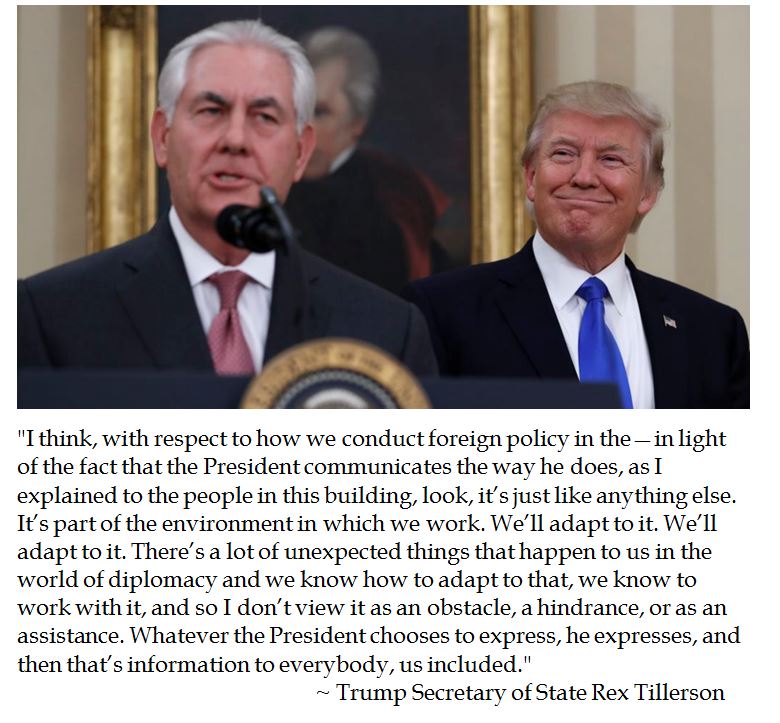
At one of the early Republican primary debates in late 2015, Hugh Hewitt questioned Mr. Trump's knowledge about the nuclear triad. Candidate Trump fumbled through the answer but insisted that while it is key to be careful about nukes, he would be well informed once in office and would concentrate on American strength not climate change and global warming. This impetus to increase America's nuclear arsenal comes in the midst of a prospective conflict with a nascent rogue nuclear North Korea as well as the prospect of finding Iran being declared out of compliance with the Obama Iran Nuclear Deal. Several concerns come from this National Security leak. Allegedly, after this July meeting, Secretary of State Tillerson was heard to call President Trump a "moron". Aside from the insult, this episode illustrates how far Rex Tillerson is out of step with the West Wing. It is reasonable to believe that once the crisis with North Korea cools down, Tillerson will no longer be at Foggy Bottom. There has been serious talk of a Trump Cabinet shuffle which CIA Director Mike Pompeo would move over to the State Department. Some arms control experts vex that increasing America's nuclear stockpile would spur an arms race with the Russia Federation as well as the Peoples' Republic of China. Moreover, increases would challenge America's international treaty obligations. As news about President Trump gunning to increase America's nuclear stockpile leaked out, Trump National Security Adviser Lt. General H.R. McMaster stated:
"But in recent years, in particular, the problem with leaks has become a real challenge to national security and so I think what is very important is that everyone who is involved in these sort of policy discussions understand the sacred trust that is placed in them, and they realize that speaking to the media about government deliberations is treasonous when it involves national security."
Those are bold words, meant to quell an alluvia of embarrassing leaks meant to damage the Trump Administration. But Lt. Gen. McMaster upped the ante by intimating treason. The question is whether the Trump Justice Department will be all talk and no action. Attorney General Sessions has allegedly demurred from seeking prosecutions of Democrats concerning Hillary Clinton's repeated mishandling of classified emails. Treason is a much more serious charge and more challenging to prosecute.
During his nomination hearings, Tillerson was vilified for his role at Exxon and connections to Big Oil. But through these petrochemical connections, Tillerson was said to have cultivated good relations with the Russian Federation. It does not seem that Tillerson has neither been effective in lessening tensions with Moscow nor distancing the Trump Administration from accusations of Russian collusion. One of Tillerson's virtues was that he had more of a business background than a political resume, thus his organizational skills might be different at Foggy Bottom. Perhaps this may be true on paper, but Secretary of State Tillerson seemed reluctant to clean house at the State Department. In April 2017, well after his confirmation, Tillerson indicated that he was in no rush to fill nearly 200 State Department posts. In August 2017, Tillerson announced that there would be fewer promotions at State. These may have been an attempt at pruning an overstaffed State Department, but it also gave the opportunity for Obama Administration holdovers to exert undue influence in Foggy Bottom. One of the major motivations for many loyal Trump voters is to "Clean the Swamp". In other words, to divest power from progressive elites who have burrowed their way into the bureaucracy. This is especially true in the State Department. But this is impossible to achieve if the chief acts like a short termer. In late July 2017, Tillerson confided with friends that he did not expect to last a year on the job. Notwithstanding his recent denial of resigning over the moron kerfuffle, Tillerson is not taking the broad measures to clean house. The Iran Deal is an example in which the State Department has been enthusiastic in promoting and preserving, yet it is in conflict with Mr. Trump's campaign promises as well as inklings from the West Wing. A cabinet official who is deemed a short termer will have little sway with the bureaucracy in aligning with the President's foreign policy predilections. Secretaries of State can take different tacks to their job. Henry Kissinger, who was Secretary of State under Presidents Nixon and Ford, took a leading role in formulating the realpolitik and detente foreign policies. George Schultz, President Reagan's long serving Secretary of State, did not seek the limelight and was able to earn the loyalty of State Department officers by staffing for professionalism rather than political concerns. Hillary Clinton, President Obama's First Secretary of State, did her bosses bidding by racking up frequent flier miles in visiting diplomatic outposts rather than take the lead on foreign policy. Aside from trying to shrink the size of the State Department by attrition and to stop relying on special envoys, it is unclear how Secretary of State Tillerson is making a difference at his job. Moreover, the friction between Tillerson and Trump on personal and policy fronts, makes his position tenuous.
At a time in which Americans have been distracted by ephemeral issues like the NFL Taking the Knee during the National Anthem and dealing with disasters, such as hurricanes and the Las Vegas shooting, there are serious foreign policy concerns brewing. North Korea continues to be belligerent. The world will no longer buy the peace through bribes for worthless promises of non-aggression or denuclearization. While the United Nations has applied additional sanctions, this does not seem to be achieving the objective of de-escalation of tension or DPRK regime change.
Considering a prospective conflict with North Korea, it would be unwise to have Secretary Tillerson leave his Secretary of State post at this time. However, presuming this situation with the Kim Jung Un regime comes to a head in the near future, it would be prudent to have a Secretary of State who is more in tune with the Commander-in-Chief's expectations for Foggy Bottom and who more accurately reflects (at least in public) the President's foreign policy positions.