Some consider the Nation’s Capital as “Fantasyland on the Potomac”. Other outsiders are “Fed Up” with the Federal City. It's better to consider D.C. as “the District of Calamity” (sic).
As if more than a handful of vulnerable Senate Democrats would allow for a confirmation vote of Neil Gorsuch.
It is dubious that the public applies this legitimacy standard to the packed DC Circuit, which then Senate Majority Leader Harry Reid first used the nuclear option. Hence it is not as much the "nuclear option" as the clarification of the Reid Rule.
Some may justly argue that it is the Constitutional Option, as cloture is nowhere in America's organic organizational documents, but merely a modern Senate innovation (first implemented in 1917 and modified in 1975).
Once again, thank you Dirty Harry Reid. Now it will be easier for President Trump (and future Chief Executives) to nominate and confirm Justices who are not mysteries nor necessarily amenable to the political Senate minority of the time.
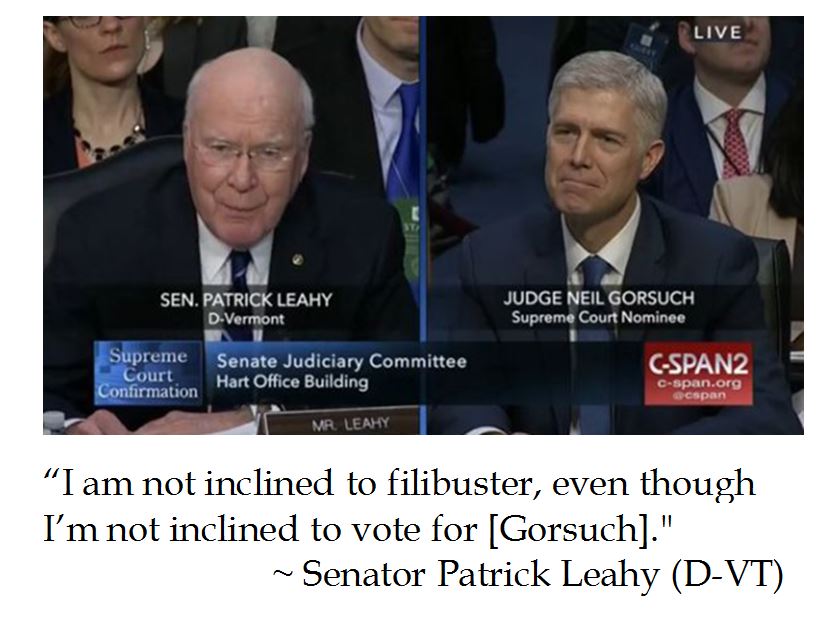
Even though Senate Minority Leader Chuck Schumer has reiterated his intent to invoke a filibuster on the cloture vote for President Trump's Supreme Court nominee Neil Gorsuch, not all of his colleagues are on board. Veteran Senator Patrick Leahy, who offered vigorous invigilation during Gorsuch's Senate Judiciary Committee appearance, indicated that he is not inclined to filibuster the nominee.
A legacy of former Senate Majority Leader Harry Reid (D-NV) was the effective elimination of the confirmation filibuster.
Under the Constitution, it is the Senate's duty to confirm Executive and Judicial Branch appointments. Senate rules allowed for confirmations with mere majorities, but needed to obtain 60 votes to cut off debate (Cloture) and preclude a filibuster. The Cloture vote was intended to prevent endless obstructionism while still giving the minority some say in the proceedings of the Upper Chamber of Congress.
Needing to get enough votes for cloture was an incentive for Republicans to select more moderate appointees which required Senate consent. But such Senate niceties stopped political steamrolling by Majorities who wished to exercise their unadulterated will.
When the Obama Administration sought to pack the Court of Appeals for DC (aka the DC Circuit), which is the court of authority for regulatory bodies, it ran into trouble when its candidates might not have received the requisite support for a Cloture Vote. So then Senate Majority Leader Harry Reid, exercised "The Nuclear Option". Exercising the Nuclear Option had been hotly debated in the preceding decade, but then Senate Majority Leader Bill Frist (R-TN) opted not to circumvent tradition.
Through Parliamentary legerdemain, Reid established a precedent in which he said that all judicial nominees, save Justices of the Supreme Court, would be considered on majority votes and did not have to pass the Cloture Vote threshold.
The Reid Rule was great when one's party is in control of the Senate and the White House. But in 2017, President Donald Trump will occupy the White House and Republicans have a two seat majority in the Senate. Incoming Senate Minority Leader Chuck Schumer thinks that he can stymie the Trump Administration through the advice and consent clause as well as any Supreme Court nominations which do not represent progressive Democrat values. However, Schumer may well rue the Reid rule legacy from Dirty Harry Reid.
Senator Ted Cruz (R-TX) and Salem Radio host Hugh Hewitt had an informative colloquy on the Reid Rule.
Republicans may not moderate their choices for positions which need to be confirmed by the Senate. Despite Harry Reid's contention that the "Reid Rule" excludes Supreme Court nominees, it is contented that avoiding Cloture for a Supreme Court nomination would simply be a second application of the Reid Rule precedent.