

Some consider the Nation’s Capital as “Fantasyland on the Potomac”. Other outsiders are “Fed Up” with the Federal City. It's better to consider D.C. as “the District of Calamity” (sic).
Showing posts with label Kevin McCarthy. Show all posts
Showing posts with label Kevin McCarthy. Show all posts
Tuesday, November 15, 2016

Tuesday, October 27, 2015
What Makes for a Good Speaker?
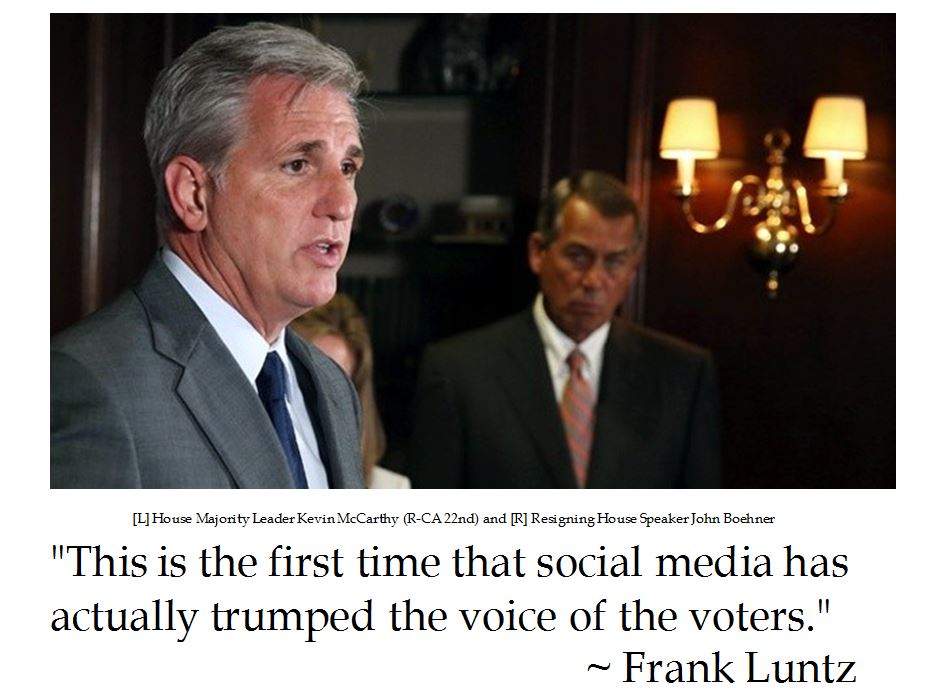
 After four and a half years as Speaker of the House, Rep. John Boehner (R-OH 8th) announced his resignation. Boehner allegedly wanted to resign after the 112th Congress but his handpicked heir, seven term incumbent former Majority Leader Eric Cantor (R-VA 7th), but he was ignominously upset by Rep. Dave Brat (R-VA 7th) in the Republican Primary. So Boehner blustered that he wanted to resign after the pinnacle of his career in hosting Pope Francis to speak before a joint session of Congress. Of course, this “Zip-a-Dee Doo Dah” excuse conveniently ignores the looming Rep. Mark Meadows (R-NC 11th) Motion to Vacate the Chair, which the Speaker would either lose or have to win with Democrat votes. Boehner gave a month for his resignation to take effect in late October, 2015.
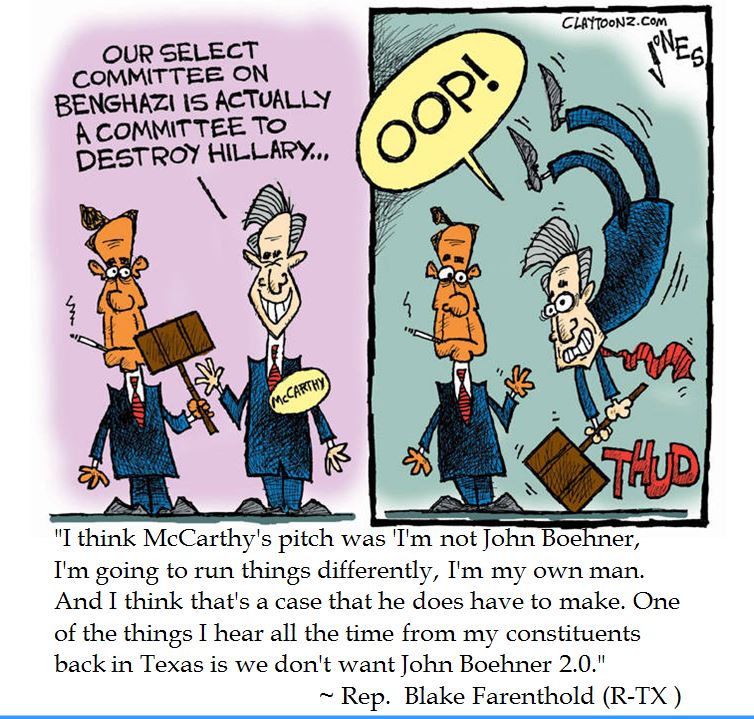
It is a good thing that Speaker Boehner gave a month to let things shake it. Everything was arranged for Majority Leader Rep. Kevin McCarthy (R-CA 23rd prior 22nd) to assume the big chair. But then McCarthy opened his big mouth during a friendly interview with Sean Hannity in which inartful articulation about Hillary Clinton blew two years of non-partisan investigation by House Select Benghazi Committee chairman Rep. Trey Gowdy (R-SC 4th).
McCarthy’s gaffe enlarged a gulf between the House Republican establishment and the Freedom Caucus, which was reluctant to back a Cocktail Party candidate. The Freedom Caucus had been poised to support Rep. Daniel Webster (R-FL 8th), who is less conservative then the Freedom Caucus but open to rules reform. However, before the Republican Caucus secretly voted on their choice, McCarthy suddenly resigned and the vote never took place.

 Paul Ryan was hailed as a conservative when he was chosen to be former Governor Mitt Romney’s (R-MA) running mate in 2012, yet was run down by some radicalized conservatives for his stance reformist inclinations on immigration. As Ryan readied himself to possibly assume the Speakership, he tapped David Hoppe, a veteran conservative who now works at the Heritage Foundation to be his chief of staff. Yet even this move was characterized by discontented populists as “picking a Washington lobbyist”. Moreover, some said that the Freedom Caucus would be sell outs if they backed Paul Ryan for speaker. But a super majority (but not 80%) of the Freedom Caucus expressed willingness to support Ryan for Speaker so the Wisconsin Congressman put his name forward for consideration.
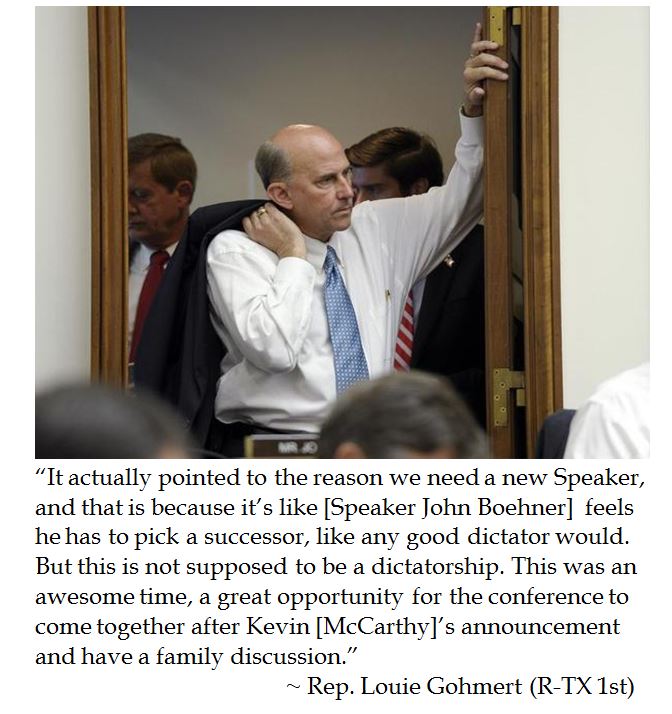
Keeping these recent events in mind, it would be wise to discern what makes for a good Speaker. Some would claim, res ipsa loquitur, that the person must be able to speak. Thus, Kevin McCarthy’s disjointed utterances should have disqualified him. There is no doubt that the Hannity snafu killed McCarthy’s bid to be Speaker. But it was not because he was not articulate in his utterances. Former Democrat House Speaker and now Minority Leader Rep. Nancy Pelosi (D-CA 12th prior 5th and 8th) was not a skilled speaker but was on message and ruled her caucus with an iron fist (and is aided by a sympathetic mainstream media). Looking back into recent history, Rep. Denny Hastert was not chosen to be the chief spokesman for Republicans or the House. Neither was Rep. Tom Foley (D-WA 5th).
On the other hand, Rep. Newt Gingrich (R-GA 6th), Rep. Jim Wright (D-TX 12th) and Rep. Tip O’Neil (D-MA 8th) were able media front men while being Speaker. So being clean, well spoken and articulate, to borrow a compliment from Vice President Joe Biden, can augment the Speaker’s role but is not quintessential.
A second trait often associated with the House Speakership is as a fundraiser. This would have been a task that Rep. Kevin McCarthy would have excelled at, lest the Benghazi bungle. Boehner seems to have done well at raising funds, particularly for those who would support establishment leadership. But this party role is something which Rep. Paul Ryan did not relish. Obviously, it is ancillary to the job of being Speaker of the House and constitutionally the second in the line of succession to the Presidency.
A third quality associated with being Speaker is setting priorities. Newt Gingrich was legionary for nationalizing the 1994 cycle and voting on the Contract with America in the first 100 days of the 104th Congress. Nancy Pelosi rallied her caucus in supporting legislation which impeded the waning George W. Bush administration in the 110th Congress and facilitated President Barack Obama’s agenda in the 111th Congress.
While current Speaker John Boehner has done some things to quell conservatives in the GOP caucus, like eventually launching the Benghazi Select Committee, suing about Obamacare and recently establishing a select committee to study Planned Parenthood abuses, his style tended to be top down and accommodating the powers that be in the White House. For instance, the lawsuit on Obamacare is window dressing with little chance of success (as it is a political issue that courts will eschew). Congress voted many times to repeal Obamacare, but it was not really attached to budgets or fought for doggedly in conference committees.
Boehner also reneged on understandings which irked the base and conservatives. For instance, Boehner repeatedly broke the Hastert Rule (bills must receive a majority of the majority to be put on the floor). This meant that legislation passed with Democrat votes. Boehner would also jam down bills, like a continuing resolution or other lengthy legislation without giving members (and the public) three days to read it before voting. So, to echo Nancy Pelosi on Obamacare, “We have to vote on the bill before we know what is in it.”. Not a wise way to run a railroad.
Many rank-and-file conservatives wanted one of their own to be Speaker. So social media pushed Trey Gowdy or Freedom Caucus leader Rep. Jim Jordan (R-OH 4th). This is under the assumption that a true Conservative would dominate the GOP caucus and get things done.
 |
| [L] Rep. Jim Jordan (R-OH 4th) [R] Rep. Raul Labrador (R-ID 1st) [photo: BD Matt] |
Well, the popular press has branded the Freedom Caucus as being ultra-right wingers bent on their own way. But at the October Conservation with Conservatives presser, Rep. Raul Labrador (R-ID 1st) struck a much more restrained set of expectations. The Freedom Caucus realized that with unity of around 38 votes they had a certain amount of power, to deny a candidate the requisite 218 votes, but they could not successfully back one of their own as Speaker.
 It may seem strange that a Republican member generally considered an up and coming Conservative like Rep. Jason Chaffetz (R-UT 3rd) only got lukewarm support in his bid for Speaker, as the Freedom Caucus was initially poised to back Rep. Daniel Webster, who had a 57% Liberty rating. Rather than have a conservative warrior in the big chair, they wanted someone who would hear their voice.
What really bothered members of the Freedom Caucus was process issues. They were tired of being shut out in the Committee process, not being able to advance their own legislation or offer amendments during mark-ups. Ironically, this was not always because their amendments might lose, but that they could carry the day and ruin the pre-baked cake that House leadership had concocted with their counterparts in the Senate or across Pennsylvania Avenue.
Webster promised to have a bottom up leadership process and that influenced the Freedom Caucus. While Ryan issued some daring demands (like get rid of the Motion to Vacate the Chair), he seems to have mollified the Freedom Caucus. Scuttlebutt is that Ryan promised to not raise immigration reform until there is a new President. Politico reported that the Freedom Caucus and Ryan agreed in principle on most items and the Freedom Caucus would have some “buy in” on legislation, but his candidacy was still “take it or leave it”. That was still good enough for 70% of the House Freedom Caucus.
This meeting of the minds did not win over all anti-establishment Republicans. Rush Limbaugh posulated that to donor class got what they wanted in Paul Ryan. Glenn Beck accused the Freedom Caucus of being sell-outs. But Beck wanted the House to look outside of its chambers to find a leader, by endorsing Senator Ben Sasse's (R-NB) modest proposal to draft AEI President Arthur Brooks. In addition, Mark Levin railed at Ryan for never meeting a bailout he did not like.
Ryan may not be the essential man for Speaker but one wonders what Conservative critics want. Who would they choose and why? If no one is likely to win, would firebrands be OK with Speaker Boehner remaining in place? This is why discerning what makes a good Speaker matters to understand what candidate to support and appreciating the consequences of the choice.
Representative Ryan tends to be a conservative but has some bagging regarding bailouts and lingering concerns about immigration. If he becomes Speaker, he may not be out of the rubber chicken circuit as much fundraising. But Ryan will probably be more of a media friendly face of the House and can articulate the Republican message. Ryan’s reluctance to leave the Ways and Means Committee is because he wanted to radically reform our tax code from the burdensome stack of bureaucratic regulations. It remains to be seen if this reformist impetus can be instituted while in the Speaker’s chair.
The Republican House Caucus will vote in secret on October 28th. If Ryan is a clear winner, then a formal floor vote should follow on October 29th as Boehner steps down. But if the votes are not they, all hell will break loose and the House will need to discern what makes for an acceptable choice for Speaker. When Gingrich resigned in 1998, Rep. Bob Livingston (R-LA 1st) was poised to be Head of the House, but some kinks came up in that ascension, which brought about Speaker Denny Hastert.
Friday, October 9, 2015
Scrutinizing Hillary Clinton's E-Mails and Sidney Blumenthal
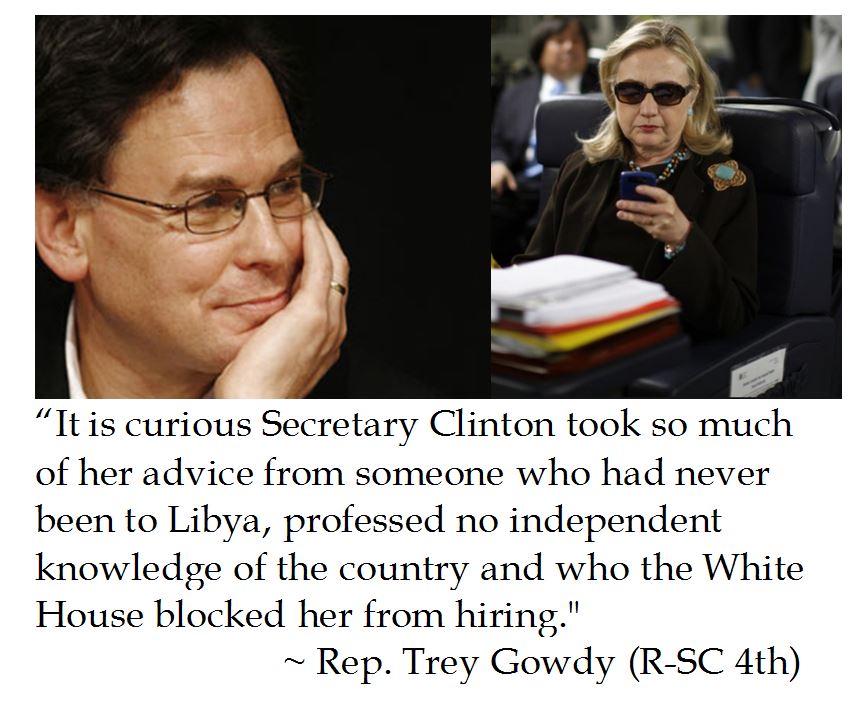
In the aftermath of GOP Majority Leader Kevin McCarthy's misstatement that the Benghazi hearings is a Hillary Clinton political witch hunt, House Benghazi Committee Chairman Representative Trey Gowdy (R-SC 4th) sent a fiery letter to Benghazi Committee Ranking Member Elijah Cummings (D-MD 7th) sharing some findings about the former Secretary of State's e-mails.
Chairman Gowdy accused Clinton confidante Sidney Blumenthal of exposing a secret source in Libya as he lobbied the then Secretary of State for business concessions in Libya.
These sorts of specific anomalies will be at the heart of
Thursday, October 8, 2015
Tuesday, October 6, 2015
Senatorial Sasse-iness (sic) on Choice for Speaker

Freshman Senator Ben Sasse (R-NE) generated a social media storm as he chimed in on choices for the Speaker of House chair which will be open at the end of October.
 It was unclear if Senator Sasse was tweeting tongue in cheek or it was serious Sasse-iness (sic) when he suggested electing American Enterprise Institute President Arthur Brooks for Speaker or if his choice epitomized the qualities of vision, hard work, resolve and wit which Sasse believes is key to be an effective Speaker.
Prior to his social media sharing, Sasse hoped that the Speaker's election would be a transformational debate on the direction of the country, as opposed a discussion as to whether conservatives could be placated.
Sasse did not express any favoritism towards the three announced Speaker candidates: Majority Leader Rep. Kevin McCarthy (R-CA 23rd) who Speaker Boehner favors; Rep. Daniel Webster (R-FL 8th) who first defeated Rep. Alan Grayson (D-FL 8th now 9th and running for Senate) and House Government Reform Chair Rep. Jason Chaffetz (R-UT 3rd).
 |
| [L] Rep. Kevin McCarthy (R-CA 23) [C] Rep. Daniel Webster (R-FL 8th) [R] Rep. Jason Chaffetz (R-UT 3rd) |
When pressed about what Nebraskan voters thought about the Speaker's race, Sasse candidly quipped: "You can't really go anywhere in Nebraska where anyone cases about that question. They don't care. They think Congress sucks."
The House Republican caucus will meet on Thursday October 8th to vote for Speaker. Rep. McCarthy insists that he has 200 votes for Speaker. But the anonymity for votes in the Caucus might not yield as much support as the Majority Leader expects.
And if no candidate reaches 218 votes (or a majority if members vote "present" or miss the vote) when the full House considers the measure, then an interim speaker takes over, which may be the Majority Leader. There is a concern that the two dozen Freedom Caucus members may vote in bloc and block McCarthy from winning.
It is interesting that the GOP Caucus has put off other votes on leadership, like a Majority Leader vote in case Mr. McCarthy is poised to ascend to the Speakership, until the day before current Speaker Boehner resigns. This might allow a candidate who has a plurality but not a majority time to garner more votes. The timing also may put pressure on members not to invite chaos in the House.
Perhaps then Arthur Brooks in the big chair might not seem like such an outlandish idea.
h/t: Politico
Wednesday, September 9, 2015
Vacant Musings About Capitol Hill


At the start of the 114th Congress, Speaker Boehner faced a revolt from two dozen Tea Party types who voted for other GOP candidates. Boehner barely won by two votes and was aided by the fact that many New York Democrats were absent for the vote to attend the funeral for Governor Mario Cuomo (D-NY). This exigency lowered the threshold for achieving a majority.
Some have speculated that insurgent Republican Congressmen could put up a liberal Republican candidate, like Rep. Peter King (R-NY 2nd), to win enough Democrat votes to take down the current king of the Hill. This notion is mistaken because it presumes that Democrats would want to replace Speaker Boehner and does not fully understand the process.
In fact, there is some speculation that John Boehner might have to rely upon Democrat votes to retain the Speaker’s chair. Arguably, House Democrats may prefer to have Boehner as Speaker if they are not going to be in the majority. However, having Democrats prop up a wounded Republican Speaker would reflect poorly upon the cosiness of the Washington political establishment and the effectiveness of the leadership.
But there might be a passive way which the Democrat caucus could prop up their favored establishment opposition. In the event that the Motion to Declare the Chair Vacant succeeds, Democrats could conveniently have a few dozen Democrats miss the vote, thereby lowering the total vote count, thereby countering the thirty GOP insurgents and re-electing Speaker Boehner.
The trick would be to accurately estimate the number of dissenting GOP votes. A similar outcome could also be achieved the helpful opposition voted “Present”, however, that would leave Democrat fingerprints on the vote.
If no candidate garners the necessary 218 votes (or a majority of those voting), then there would be subsequent votes. But like the scenario of a brokered political convention, all bets are off after the initial round. If Mr. Boehner could not achieve a majority in the first vote, power would ebb away. Without having the power of the Speaker’s chair and the ability to appoint chairmen and exile dissenters from committees, he would lose the fealty of the current leadership. In fact, current Majority Leader Rep. Kevin McCarthy (R-CA 23rd) and current House Majority Whip Steve Scalise (R-LA 1st) might not be in contention for not mooting the revolt beforehand.
With the Iran Deal, legislation to defund Planned Parenthood and passing the Budget on the docket this fall, a leadership battle could make this a very interesting time on Capitol Hill. But observing the machinations of the Senate's Corker/Cardin Iran Deal vote, don't discount the establishment's ability to choreograph "victories which seem inimical to the vox populi but keeps their Cocktail Party plans.
Subscribe to:
Posts (Atom)